
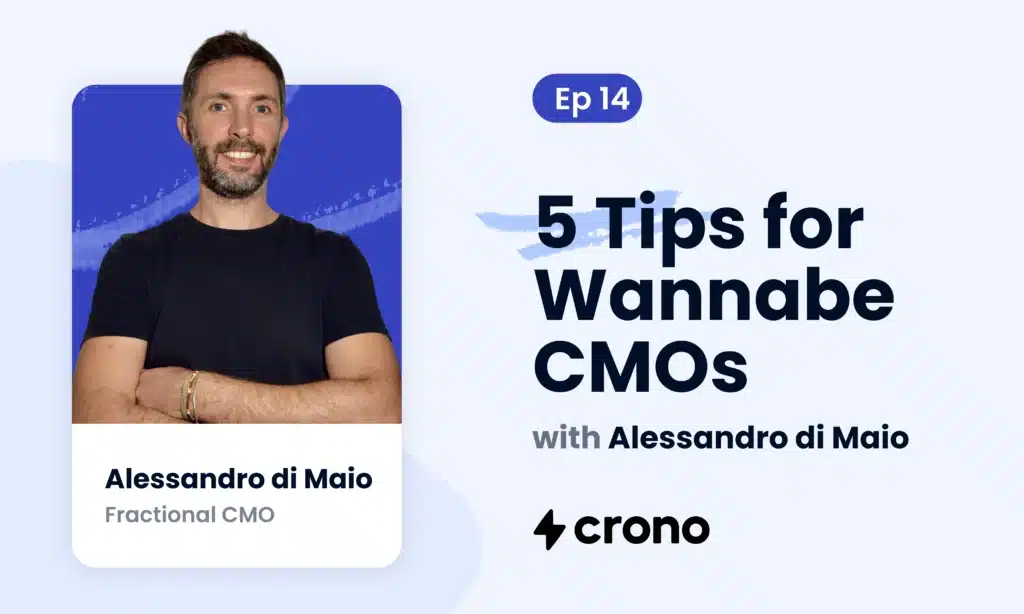
Welcome back to 5 Tips for Wannabe CMOs, our marketing column where we get to know great marketers, their stories and some inspiring tips for the next generation of CMOs.
In this episode we talked with Alessandro Di Maio, a marketing leader with over 13 years of experience and now Fractional CMO work with startups and SMEs.
He shares the mindset shifts that come with moving between corporate giants and lean teams, the failed interview that changed the direction of his career, and his five concrete tips for marketers who want to make the leap to the C-suite.
If you’re early in your marketing career, or stuck in execution and wondering how to break through, this one’s for you.
1. Let’s start with your story.
You’ve worked across global corporations but also startups and SMEs. What’s the biggest mindset shift required when moving between these very different environments?
I started my career in consulting. It didn’t take long to realize it wasn’t the right place for me and that uncomfortable realization turned out to be the first real turning point.
I’ve been in marketing since 2012 – first at Procter & Gamble, then four years at Henkel managing brands like Perlana and Dixan, then Costa Cruises, where I finally got to work on what I was missing as a marketer: segmentation, positioning, building communication insights. After eight years at Costa, I chose a different path – startups, SMEs, Fractional CMO. And that’s where the real mindset shift happened.
The biggest change isn’t technical. It’s psychological. And it has three faces.
The first is language. In large corporations, you develop an internal vocabulary that works perfectly among colleagues but means nothing outside that context. Working with SMEs and startups taught me that nobody is impressed by your ability to deploy marketing terminology. What matters is that they understand where you’re taking them and why.
The second is responsibility. Looks like a paradox, but I felt far greater weight on my shoulders managing little-to-zero budget for a startup than when working with multimillion-euro budgets at a multinational. Because in a small context, the margin for error is minimal. If you don’t deliver results within a tight timeframe, resources run out, cash flow suffers, the project closes. There’s no structure to absorb the impact. It’s on you.
The third is speed. Large organizations are slow. Structurally, not because of anyone’s fault. Multi-level approval processes, delegation cultures still being built, organizational complexity: all of this exists for a reason, but it slows everything down. In smaller contexts, you have to learn to work differently. Quality matters, but almost always done is better than perfect. Those who can’t accept that stay still while the market moves on.
2. Looking back at your 13+ years in marketing, what’s one lesson you learned early that still shapes the way you lead marketing teams today?
Late 2016, early 2017. I’ve been at Henkel for a few years, things are going well, and I go through a selection process at Ferrero. It goes badly. Not just badly. There are moments where I feel genuinely embarrassed. Not from performance anxiety, but because I realize, in real time, that in certain areas I don’t have the tools I thought I had. That uncomfortable feeling turned out to be one of the greatest gifts of my career.
Coming out of it, I understood with a clarity I’d never had before what was missing from my profile as a complete marketing professional. The entire strategic dimension (segmentation, positioning, communication direction) was still a gap. One I couldn’t afford to ignore. That awareness led me to choose Costa Cruises, where I finally got to work on everything I hadn’t touched yet at Henkel.
The lesson is simple but not trivial: the moments when you’re truly struggling are the only ones where you make real leaps forward. Not courses, not books, not positive feedback. Difficulty.
And this completely changes how I lead a team today.
If I know that growth comes through those uncomfortable moments, my job as a leader isn’t to protect people from difficulty but it’s to put them in a position to encounter it.
I know that sounds almost harsh. But bear with me.
I’m not saying leave people without support or manufacture artificial difficulties. I’m saying the worst way to guide someone is to remove every obstacle from their path because then they never learn to walk on their own. My role is to build a safety net around the team made of clear direction, adequate tools, and presence when needed that allows people to face their challenges without being overwhelmed. Genuine delegation, not lip service. Being accessible not to give answers, but to help people find their own. Coaching in the most concrete sense: accompanying, not replacing.
It’s not always possible, it’s not always compatible with the timelines you have, and not everyone on your team wants or expects this. But it’s the only way I know to genuinely develop someone.
3. Your 5 tips for wannabe CMOs: where should someone start if they dream of reaching your level?
There’s no credible CMO who hasn’t spent years truly understanding how every lever works. I’ve managed TV campaigns, local adaptations, editorial plans, creative briefs, segmentation analysis. You can’t lead a team if you don’t know what it means to actually do those things. Those who reach a leadership role early without ever getting their hands dirty build their authority on sand.
One of the most common mistakes among ambitious marketers is thinking about marketing as something you do to express creativity or build a portfolio. Marketing exists to help someone else achieve something. The sooner you truly understand that, the sooner you become someone who deserves to lead a marketing function.
Marketing changes faster than any other business function. When I started, social networks existed but nobody quite knew what they were for. Today, AI is rewriting the rules in real time. You can’t update yourself once a year with a course. You need to build a system: vertical newsletters for every area (performance, strategy, growth, outreach), reading habits, continuous dialogue with people working on problems different from yours.
The best CMOs I’ve encountered aren’t those who “think big.” They’re the ones who can operate on two levels simultaneously: they know where they’re going and they know what’s happening on the ground every single week. The disconnect between strategy and execution is the number one reason marketing plans fail. Train yourself to move between levels without losing coherence.
Every opportunity I pursued carefully — Henkel to learn operational marketing, Costa for strategy, startups to learn how to adapt with limited resources — wasn’t a choice about job title. It was a choice about what I wanted to learn at that moment. If you’re choosing your next move by looking only at the hierarchical level, you’re using the wrong criteria.
4. What advice would you give to marketers who aspire to become CMOs but feel stuck in execution-heavy roles?
The first thing I always say is: stop seeing execution as an obstacle.
It’s the only place where you can truly get good at understanding what works and what doesn’t.
That said, there’s a real trap: doing things well without ever asking why they’re being done. If you’re in a pure execution role, the risk is developing technical competence but not the muscle for strategic thinking. The way out isn’t necessarily changing jobs. It’s changing how you do the job you already have. Every activity you execute has objectives behind it. Train yourself to always trace back to those objectives, to question decisions, to propose alternatives. Not to be difficult, but because that’s how you build the thinking of someone who leads.
And then there’s the competition issue, which many people underestimate.
The jump from any management role to CMO is a significant one. Those looking for a CMO want someone who has already proven they can do that job or who presents the lowest possible risk to the company. And today, with LinkedIn, anyone can reach anyone. This means you can’t simply wait for someone willing to bet on you. Because in your same pool of candidates, there will almost always be someone who has already made that leap and is already demonstrating they’re worth that position.
If you want to win that competition, you need to do something others typically don’t: build for yourself the opportunity to already be what you aren’t yet formally.
Side projects, private consulting, collaborations even pro bono if necessary. It’s not something everyone does, and I’m not here to debate whether it’s fair or not. But it’s something that differentiates you because it concretely demonstrates how you work, how you think, what you’re willing to do to reach an objective. If I were a company, I would almost always prefer to hire someone who finds any way to get where they want to go, over someone who waits for permission.
I did it myself. When I decided to shift contexts and focus on smaller realities, I hit closed doors. I had to start activating spot collaborations, in parallel with my job, outside work hours, sometimes without compensation to prove to myself and to the market that I was worth that position in contexts I hadn’t yet worked in. It wasn’t easy. But it was the only way.
5. What’s one book, resource, or habit that has had a major impact on your professional growth?
The book is The One Thing by Gary Keller.
The principle is deceptively simple: focus on the single thing that, done now, makes everything else easier or irrelevant but the leverage it creates in practice is enormous. I work with multiple clients simultaneously, in very different contexts.
Without a system that forces me to identify the real priority (not the urgent one) I’d risk doing many things adequately instead of doing a few things really well.
When it comes to marketing-specific resources, today the most efficient way to stay sharp is to have a precise system of vertical newsletters, one for each area: performance marketing, strategy, growth, outreach, AI applied to marketing. Not a generalist source that covers everything superficially. Marketing is too fragmented and evolves too quickly to rely on a single perspective. Better to have specific, carefully selected sources that keep you deeply updated on what you actually need.
6. Finally: what does “good marketing” mean to you today?
Good news: what you need today to do marketing well is the same thing you needed yesterday, and the same thing you needed the day before.
The fundamentals don’t change. And among them, there’s one that stands above the rest: listening to and genuinely understanding your target. Marketing is always and entirely for people. Whatever changes around you ( channels, tools, budgets, trends) that remains the one thing that’s non-negotiable.
Good marketing starts with the people you’re trying to serve. Not the data, not the benchmarks, not the format of the moment. The people.
There’s something I’ve understood over time that continues to guide my work: behind every campaign that seems phenomenal, behind every product that truly meets its market, there’s always someone who listened with uncommon quality. They didn’t just read a report. They genuinely understood what the person on the other side was experiencing. There are campaigns that appear extraordinarily creative, but in reality are simply the natural consequence of someone who listened in the right way. True target understanding isn’t an input to the marketing plan, it is the marketing plan somehow.
Today, with the tools available, even for small players who once couldn’t afford certain levels of communication, the gap between those who do marketing well and those who don’t has never been wider. And that gap almost always goes by the same name: understanding.
Good marketing doesn’t persuade. It reflects. It says to someone: I’ve seen you, I’ve understood you, and what I have to offer was made for you. When you truly get there, you don’t need to convince anyone.
Not sure where to start?
Let's talk.
Schedule a session with one of our specialists and get our exclusive Sales Playbook 2026 for free.
 BANT, SPICED & MEDDPICC frameworks
30+ ready-to-use sales templates
2026 outbound & pipeline benchmarks
Don’t sell the product. Sell the change the product makes possible.
This playbook is step one.
