

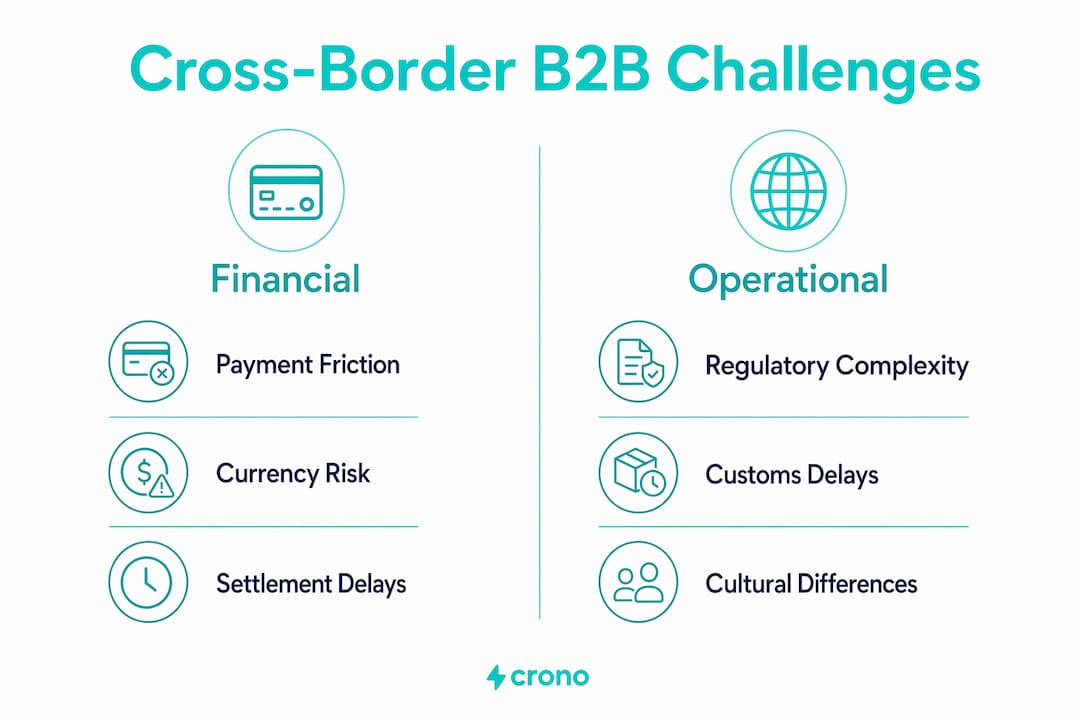
Cross-border B2B selling is complex because it stacks financial, regulatory, and cultural challenges on top of each other simultaneously. Payment friction, customs delays, and buyer behavior differences don’t appear one at a time.
They hit at once, and B2B sales complexity is accelerating. 83% of businesses report that cross-border trade operations became more complex in 2026 compared to 2025. That number tells you this isn’t a temporary friction point. It’s a structural reality that every sales executive expanding internationally must plan around from day one.
Why cross-border B2B selling is complex: the payment layer
International B2B payments are slow, expensive, and compliance-heavy by design. The system was built for domestic transactions and retrofitted for global trade. That mismatch creates real costs.
87% of businesses experience friction with international payments. Traditional wire transfers take 2–5 business days and carry $25–$75 per transaction in fees, plus 2–4% foreign exchange markups on top. For a mid-market company running dozens of international transactions per month, that adds up to a significant drag on margins.

The root cause is correspondent banking. When your bank doesn’t have a direct relationship with your buyer’s bank, the payment routes through one or more intermediary banks. Each intermediary adds processing time, fees, and a compliance checkpoint. You lose visibility into where the payment is, and your buyer loses confidence in your operational reliability.
Compliance verification compounds the problem. Know Your Business (KYB) checks and sanctions screening are mandatory at multiple points in the chain. A single flag, even a false positive, can freeze a payment for days.
- Processing delays: 2–5 business days for standard wire transfers
- Transaction fees: $25–$75 per wire, before FX costs
- FX markups: 2–4% on currency conversion, often hidden in the rate
- Compliance holds: KYB and sanctions screening can pause payments without notice
- Liquidity impact: Slow payment settlements trap working capital in correspondent banking chains, creating liquidity crunches that standard accounting systems aren’t built to handle
Pro Tip: Negotiate payment terms that account for 5–7 business day settlement windows, not 2–3. Build that buffer into your cash flow model before you sign your first international contract.
How do regulatory and customs complexities add to cross-border B2B challenges?
Regulatory fragmentation is the defining cross-border trade difficulty of 2026. Rules differ by country, by product category, by transaction type, and by the political relationship between trading partners. They also change fast. Global trade rules are shifting faster than ever, and companies that treat regulatory friction as an occasional hurdle rather than a constant variable get caught off guard.
Customs clearance is where regulatory complexity becomes a financial event. A federal system glitch in Canadian customs caused losses of $3.3 million for every 4-hour delay to truckers in Ontario, Quebec, and Manitoba. That’s not a worst-case scenario. That’s what happens when a single system dependency fails in a high-volume trade corridor.
| Regulatory challenge | Operational impact |
|---|---|
| Fragmented tax rules | Separate VAT, GST, and sales tax filings per jurisdiction |
| Customs documentation errors | Shipment holds, fines, and delivery delays |
| Sanctions and export controls | Compliance failures that block entire markets |
| Policy volatility | Tariff changes that invalidate pricing models mid-contract |
| Reporting obligations | Inconsistent data requirements across trading partners |
Geopolitical uncertainty adds another layer. Tariff changes between major trading blocs can invalidate a pricing model that took months to build. Sales teams that locked in multi-year contracts without tariff adjustment clauses have learned this the hard way.
Pro Tip: Build a regulatory monitoring function into your international GTM plan from the start. Assign someone to track policy changes in each target market, not just at launch but on a quarterly basis.
Why do cultural and buyer behavior differences influence cross-border B2B sales complexity?
GTM misalignment is the primary reason US B2B firms fail in Europe. Not execution quality. Not product fit. The failure happens because American sales teams treat European markets as a larger version of the US market, and they aren’t. Over 80% of American B2B companies fail when expanding into European markets due to this exact misdiagnosis.
European B2B buying is trust-first. Speed and volume, the metrics that drive US outbound sales, signal the wrong things to European buyers. A high-frequency outreach sequence reads as pressure, not enthusiasm. A case study from a US reference customer carries little weight without a local equivalent.
“European B2B deals typically involve a consensus buying committee from IT, legal, finance, and functional teams, each needing independent satisfaction and trust in the vendor. Winning one champion is not enough. You need to earn the confidence of every stakeholder in the room.”
In DACH markets specifically, procurement requires local language support and trusted local references. Foreign case studies without local presence signal a lack of commitment. That perception alone can end a deal before a proposal is submitted. Building trust online through localized content, local partnerships, and ecosystem credibility is not optional in these markets. It’s the entry requirement.
Sales strategy adaptations for diverse cultural contexts include:
- Lengthen your sales cycle expectations. European deals run longer than US equivalents. Plan for it in your forecasting.
- Map the buying committee early. Identify IT, legal, finance, and functional stakeholders before your first discovery call.
- Invest in local references. One local customer reference outweighs ten US case studies in most European procurement processes.
- Localize your materials. Language and tone matter. German procurement teams expect formal, detailed documentation. Scandinavian buyers expect directness and transparency on pricing.
- Hire local ecosystem partners. A trusted local reseller or systems integrator can compress the trust-building timeline significantly.
How do supply chain and logistics challenges make cross-border B2B selling harder?
Supply chain reliability is a sales problem, not just an operations problem. When you sell internationally, your delivery commitments become part of your value proposition. Missed delivery windows damage buyer relationships and create contract disputes.
Border delays are the most common source of supply chain disruption in cross-border trade. Customs system outages, documentation errors, and inspection holds can stop a shipment for hours or days. The $3.3 million per 4-hour delay figure from Canadian customs illustrates the financial scale of what looks like a routine administrative problem.
Longer shipping times also change how buyers evaluate vendors. A domestic buyer might accept a 3-day delivery window. An international buyer in a different time zone, working with a different logistics network, needs more predictability, not just speed. Contracts that don’t account for cross-border shipping variability create disputes when reality diverges from the agreed timeline.
Key supply chain risks in cross-border B2B selling:
- Customs system failures: Government IT outages can halt clearance with no warning and no workaround
- Documentation errors: A single incorrect field on a customs form can trigger a hold or a fine
- Multi-leg shipping complexity: More handoffs mean more points of failure and less visibility
- Inventory positioning: Holding stock in-market reduces delay risk but increases capital requirements
- Carrier reliability variance: International carrier performance varies significantly by corridor and season
Proactive communication is the most underrated tool in managing these risks. Buyers who receive early warning of a delay are far more forgiving than buyers who discover it themselves.
What operational strategies help manage cross-border B2B selling complexity?
The companies that succeed in cross-border B2B selling treat complexity as a system design problem, not a sales problem. Mid-market businesses succeed by connecting tax, compliance, risk, and operations into unified control structures. That integration converts complexity from a cost center into a competitive advantage.
Here are the operational strategies that make the biggest difference:
- Build a unified control structure. Connect your tax, compliance, risk, and operations functions so they share data and flag issues in real time. Siloed functions create blind spots that become expensive surprises.
- Run a 180-day market validation phase. Successful international GTM requires a validation phase focused on ecosystem credibility and regulatory confidence before scaling. Don’t hire a full sales team until you’ve validated product-market fit and compliance readiness in the target market.
- Adapt your treasury management. Standard accounting systems aren’t built for multi-day payment settlement delays. Build cash flow models that account for 5–7 day settlement windows and maintain liquidity buffers for high-volume international periods.
- Invest in local ecosystem presence. Partnerships with local resellers, consultants, and industry associations build the credibility that cold outreach cannot. This is especially true in European and APAC markets.
- Use sales orchestration tools to manage longer, multi-stakeholder cycles. Cross-border deals involve more touchpoints, more stakeholders, and more time. Automation and workflow tools keep your team coordinated across time zones and sales stages.
Pro Tip: Treat your first international customer as a reference-building investment, not just a revenue event. A referenceable local customer is worth more than the contract value in markets where trust drives buying decisions.
Key Takeaways
Cross-border B2B selling fails most often when sales teams underestimate the combined weight of payment friction, regulatory fragmentation, and cultural misalignment operating at the same time.
| Point | Details |
|---|---|
| Payment friction is structural | Wire transfers cost $25–$75 per transaction plus 2–4% FX markups, and 87% of businesses report friction. |
| Regulatory complexity is accelerating | 83% of businesses report increased cross-border trade complexity in 2026 versus 2025. |
| Cultural misalignment drives failure | Over 80% of US B2B firms fail in Europe by misreading trust-first buying behavior as slow decision-making. |
| Unified operations reduce risk | Connecting tax, compliance, risk, and operations into one control structure converts complexity into advantage. |
| Market validation before scaling | A 180-day validation phase focused on ecosystem credibility reduces failure risk in new international markets. |
What I’ve learned about cross-border B2B selling the hard way
The biggest mistake I see sales executives make is treating regulatory complexity as a one-time setup cost. You research the rules, you get compliant, and you assume you’re done. You’re not. Regulations change, trade relationships shift, and what was compliant in january may require a filing update by september. The teams that build ongoing regulatory monitoring into their operations outperform the ones that treat it as a launch checklist item.
The second lesson is patience in trust-building. I’ve watched US sales teams burn through European pipeline by running the same high-cadence outreach sequences they use domestically. The response isn’t silence because the product is wrong. It’s silence because the approach signals that you don’t understand how buying decisions get made in that market. Slowing down, investing in local presence, and earning credibility through ecosystem relationships produces better results than volume ever will.
Technology helps, but it doesn’t replace judgment. AI-powered B2B market expansion tools can surface signals, automate follow-up, and keep complex multi-stakeholder deals organized across time zones. What they can’t do is tell you which local partner to trust or how to read a procurement committee’s hesitation. That still requires human experience and cultural intelligence.
How Crono helps sales teams handle cross-border complexity
Cross-border B2B deals are longer, involve more stakeholders, and require more coordination than domestic deals. That’s exactly where Crono’s Agentic Sales Engine earns its place in your stack.
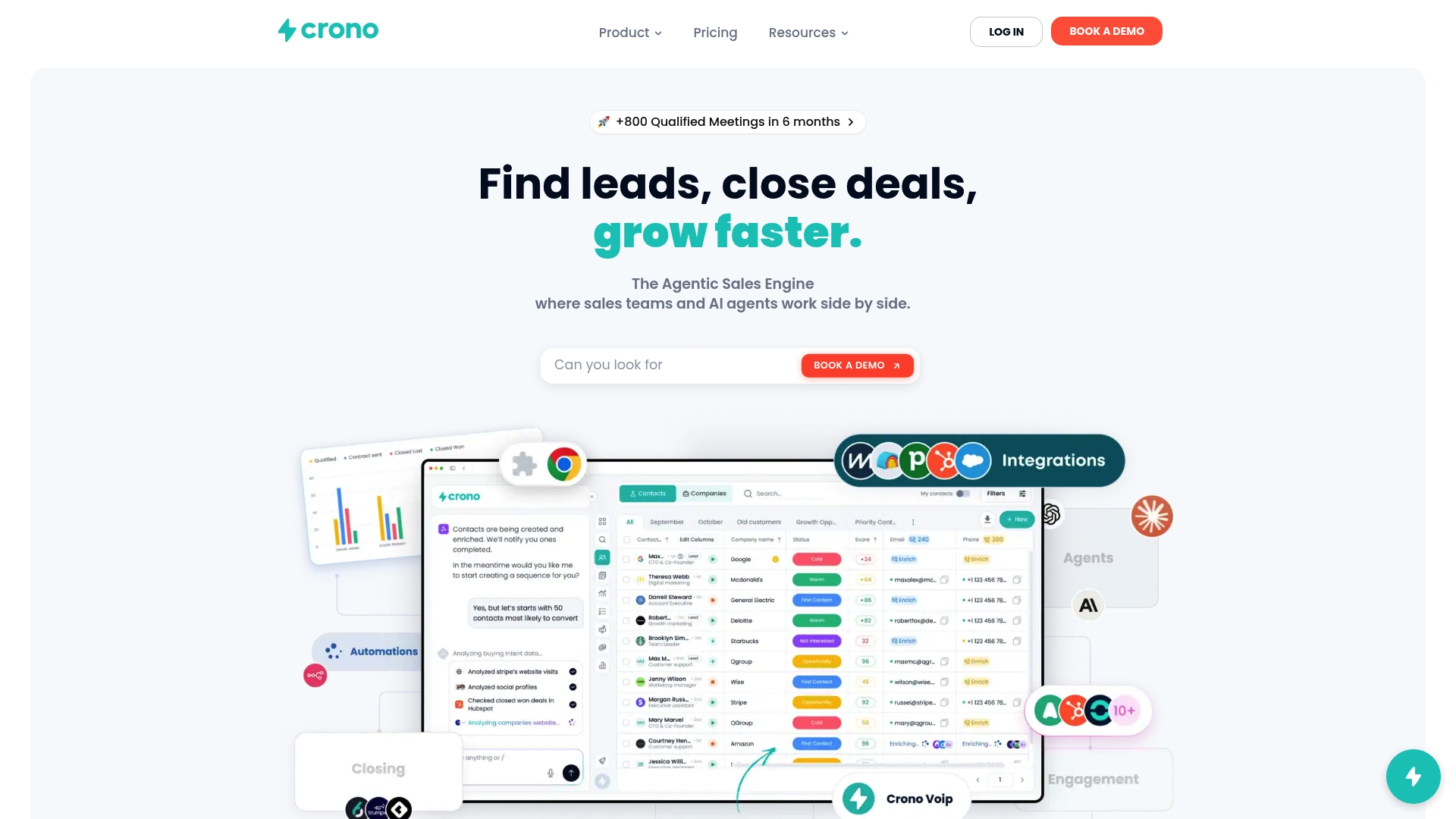
Crono combines AI agents, workflow automation, data enrichment, and multichannel engagement in a single platform. Your team can manage multi-stakeholder European buying committees, track compliance-sensitive deal stages, and run localized outreach sequences without switching between tools. For sales teams running complex B2B sales orchestration across multiple international markets, Crono acts as the execution layer that keeps every deal moving. You can also explore AI sales agents to automate the high-volume coordination work that cross-border cycles demand.
FAQ
What makes cross-border B2B payments so difficult?
87% of businesses report payment friction in international transactions, driven by correspondent banking delays, $25–$75 wire fees, 2–4% FX markups, and mandatory KYB and sanctions compliance checks at multiple points in the payment chain.
Why do US B2B companies fail in European markets?
Over 80% of US B2B firms fail in Europe because they misread trust-first buying behavior. European deals require consensus across IT, legal, finance, and functional teams, and local references carry far more weight than US case studies.
How does regulatory fragmentation affect cross-border B2B sales?
Regulatory fragmentation forces companies to manage separate tax filings, customs documentation, export controls, and reporting obligations in each market. 83% of businesses report that this complexity increased in 2026, making agile compliance operations a competitive requirement.
What is the best way to validate a new international B2B market?
A 180-day validation phase focused on ecosystem credibility and regulatory confidence reduces failure risk before you commit to full-scale hiring and pipeline investment in a new market.
How do supply chain delays affect B2B cross-border deals?
Customs delays create direct financial losses. A federal system glitch in Canada caused $3.3 million in losses per 4-hour delay to truckers, illustrating how operational disruptions at the border translate directly into revenue risk for sellers and buyers alike.
