A GDPR compliant sales tool is software built to meet the data protection requirements set by the EU General Data Protection Regulation, ensuring every sales activity respects privacy rights and legal obligations. For B2B sales leaders and compliance officers, choosing the right privacy focused sales software is no longer optional. Regulators across the EU are tightening enforcement, and the cost of a violation extends well beyond fines. It reaches customer trust, pipeline velocity, and your team’s ability to prospect at scale.
This guide covers what makes a sales tool genuinely compliant, what technical and legal traps to avoid, and how to evaluate vendors with confidence.
What features make a sales tool GDPR compliant?
A GDPR compliant sales tool must do more than display a privacy policy. It must enforce data protection through technical controls baked into the product itself.
The most critical features to evaluate are:
- Data Processing Addendum (DPA): Every vendor must provide a signed DPA that specifies how they process, store, and delete personal data. A signed DPA alone is insufficient. Vendors must implement data minimization and technical controls like deletion APIs to actually fulfill GDPR obligations. Liability persists without enforcement.
- Real-time data verification: Top privacy focused sales software tools offer real-time data verification with at least 95% accuracy guarantees. Sending emails to invalid addresses triggers spam filters and draws regulatory scrutiny.
- Automated data deletion: Storage limitation is a core GDPR principle. Your tool must enforce automatic deletion schedules tied to retention policies, not rely on manual cleanup.
- Security certifications: Look for ISO 27001 and SOC 2 Type II certifications. These are independent audits that verify a vendor’s security controls are real and tested.
- DSR automation: DSR fulfillment across complex tech stacks can shift from days of manual work to under 10 minutes with automation. Enterprises average 50–100 integrated systems containing personal data, and fulfilling a single request often involves 26 people without automation.
- Consent and legitimate interest management: The tool must record the legal basis for each contact, whether consent or legitimate interest, and make that record auditable.
- Audit trails: Every data access, modification, and deletion event must be logged. This is your evidence layer during a regulatory inquiry.
Pro Tip: Ask vendors to show you a live demo of their deletion API and DSR workflow before signing. If they cannot demonstrate it in real time, the feature likely exists only on paper.
How does EU data residency and Schrems II affect compliance?

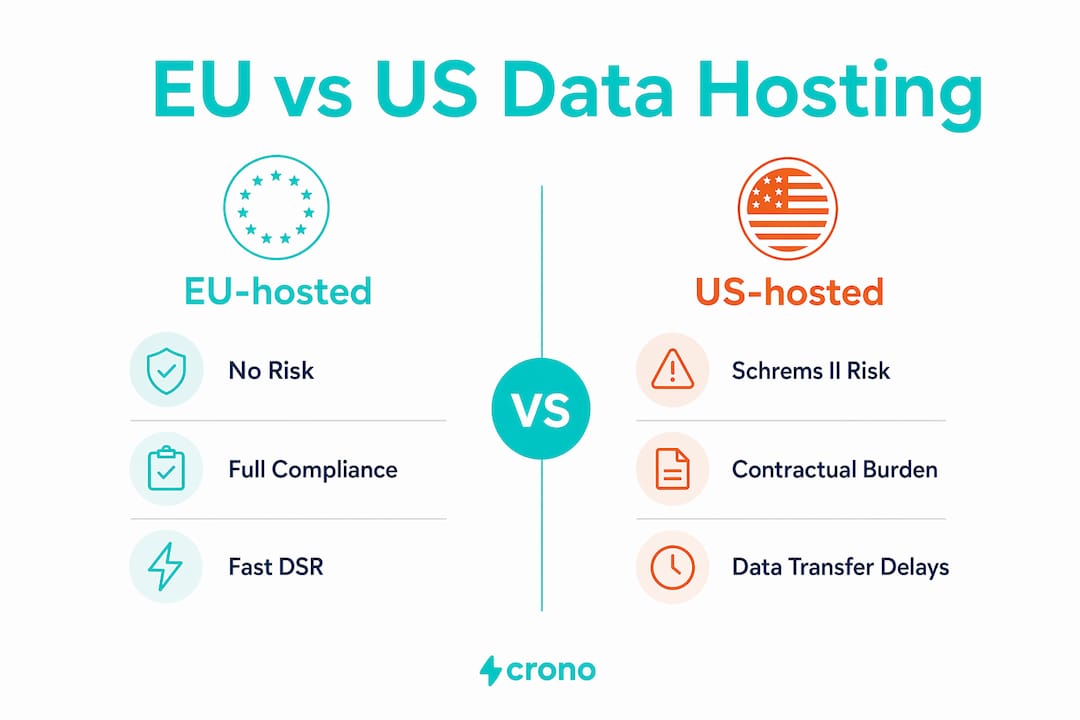
Schrems II is the 2020 Court of Justice of the EU ruling that invalidated the EU-US Privacy Shield framework. It established that transferring personal data to the United States requires additional safeguards beyond standard contractual clauses, because US surveillance law creates risks that EU data subjects cannot effectively challenge.
The practical implication for sales teams is direct. If your sales tool stores prospect data on US servers, you face a structural compliance risk that a DPA cannot fix. B2B organizations using EU-native tools avoid Schrems II violations by ensuring no data crosses to US servers. DPAs alone do not address data flow risks.
| Compliance factor | EU-hosted tool | US-hosted tool |
|---|---|---|
| Schrems II exposure | None | High |
| DPA sufficiency | Yes, with technical controls | No, additional safeguards required |
| EU regulator risk | Low | Elevated |
| Sub-processor transparency | Easier to audit | Often opaque |
Choosing tools that host data exclusively in EU regions like AWS Frankfurt or Paris mitigates Schrems II-related transfer risks effectively. The architecture of the tool matters as much as the contract.
Sub-processors are another blind spot. Your vendor may be compliant, but if they pass data to a US-based analytics or enrichment sub-processor, that transfer carries the same risk. Demand a full sub-processor list and verify each one’s data residency before signing.
Pro Tip: Request the vendor’s sub-processor list in writing and confirm each sub-processor’s data residency location. Update this review annually, because vendors add sub-processors without always notifying customers.
What are the GDPR compliance challenges with AI-powered sales tools?
AI introduces compliance complexity that standard GDPR checklists do not fully address. The two biggest risks are automated decision-making and data use for model training.
Article 22 of GDPR restricts decisions made solely by automated algorithms that significantly affect individuals without human review. In a sales context, this applies to AI-driven lead scoring that automatically disqualifies prospects, or pricing algorithms that adjust offers without a rep reviewing the output. Sales tools must include human-in-the-loop processes to remain compliant.
The five compliance checkpoints for AI-powered sales tools are:
- Human review gates: Every AI recommendation that affects a prospect’s status, pricing, or outreach eligibility must pass through a human checkpoint before execution.
- Model training restrictions: Vendor contracts must explicitly prohibit training AI models on your prospect data. Vendor clauses forbidding model training on client data are a meaningful compliance safeguard.
- Data accuracy standards: AI profiling built on inaccurate data violates the accuracy principle of GDPR and increases the risk of wrongful targeting. Maintain verified, up-to-date contact records.
- Transparency documentation: Under the EU AI Act, which runs alongside GDPR, high-risk AI systems require documentation of how decisions are made. Sales leaders should request this documentation from vendors now, before regulators do.
- Consent scope verification: AI personalization must stay within the scope of the consent or legitimate interest basis originally recorded. Using data collected for one purpose to train a different AI model is a violation.
“AI decisions with significant effects require human approval. Sales automation algorithms without oversight risk GDPR violations. The speed of AI is not a legal defense.”
Integrating human oversight in AI-powered sales workflows is the practical answer to Article 22 compliance. The goal is not to slow down automation. The goal is to put a human decision at the right point in the workflow so the automation that follows it is legally grounded.
How to evaluate and implement GDPR compliant sales tools
Selecting a sales tool for data protection requires a structured evaluation process, not just a vendor questionnaire. The evaluation must cover legal, technical, and operational dimensions simultaneously.
Start with these criteria before any demo or trial:
- Certifications on file: Confirm ISO 27001 and SOC 2 Type II certificates are current, not expired. Ask for the audit report date.
- DPA with technical controls: Verify the DPA references specific deletion timelines, data minimization requirements, and breach notification windows under 72 hours, as GDPR requires.
- EU-only data architecture: Confirm in writing that no data leaves EU-based servers and that all sub-processors are EU-resident.
- DSR automation capability: Test the DSR workflow end-to-end. Leading solutions reduce DSR response times to under 10 minutes across complex tech stacks.
- Consent management module: The tool must record and store the legal basis for each contact, support withdrawal of consent, and propagate that withdrawal across integrated systems.
- Audit trail depth: Confirm that every data event is logged with timestamps, user IDs, and action types. This is your Records of Processing Activities (RoPA) foundation.
Once you select a tool, implementation requires internal policy work alongside technical setup. Define data retention periods for each contact category and configure automated deletion to match. Train your sales team on the legal bases they can use for outreach, and document those decisions.
Pro Tip: Treat your RoPA as a living document, not a one-time compliance exercise. Organizations must move from static GDPR documentation to dynamic, evidence-based governance with living audit trails and automated risk registers.
Compliance also functions as a competitive advantage. 75% of consumers purchase only from brands they trust. In B2B sales, where procurement teams now routinely include data protection questionnaires in vendor evaluations, a demonstrably compliant sales process accelerates deals rather than slowing them down. The future of B2B sales increasingly rewards teams that treat privacy as a feature, not a constraint.
Key Takeaways
A GDPR compliant sales tool requires EU data residency, technical enforcement of deletion and consent, DSR automation, and human oversight of AI decisions to meet regulatory standards and build buyer trust.
| Point | Details |
|---|---|
| DPA is not enough | Vendors must back signed DPAs with deletion APIs, data minimization controls, and breach notification timelines. |
| EU data residency is mandatory | Schrems II makes US-hosted tools a structural risk; EU-only architecture is the only reliable fix. |
| DSR automation is the benchmark | Automated DSR processing reduces fulfillment from days to under 10 minutes across complex tech stacks. |
| AI tools need human checkpoints | Article 22 of GDPR requires human review before any automated decision significantly affects a prospect. |
| Compliance drives trust | 75% of consumers buy only from brands they trust, making privacy governance a sales advantage, not just a legal cost. |
Why compliance is the sales advantage most teams are missing
Sales leaders often treat GDPR compliance as a legal department problem. That framing costs them deals. I’ve seen procurement processes stall for weeks because a vendor could not produce a current DPA or explain where prospect data was hosted. The compliance gap became a pipeline gap.
The shift I’d encourage is this: stop auditing compliance after you choose a tool and start using compliance criteria to filter vendors before the demo. The teams that do this move faster in procurement conversations because they already have the answers buyers are asking for.
The AI dimension is where I see the most overlooked risk right now. Sales leaders are adopting AI-powered prospecting and scoring tools at speed, but very few are asking vendors the Article 22 question directly. If your AI tool can disqualify a lead or adjust outreach frequency without a human ever reviewing that decision, you have a compliance exposure. The AI tools for sales coaching that hold up under scrutiny are the ones built with human review as a design principle, not an afterthought.
My practical advice: run a compliance audit on your current sales stack before evaluating new tools. Map every system that touches prospect data, confirm its data residency, and check whether your DPAs include technical controls. What you find will clarify exactly which gaps a new tool needs to fill.
How Crono approaches GDPR compliant sales execution
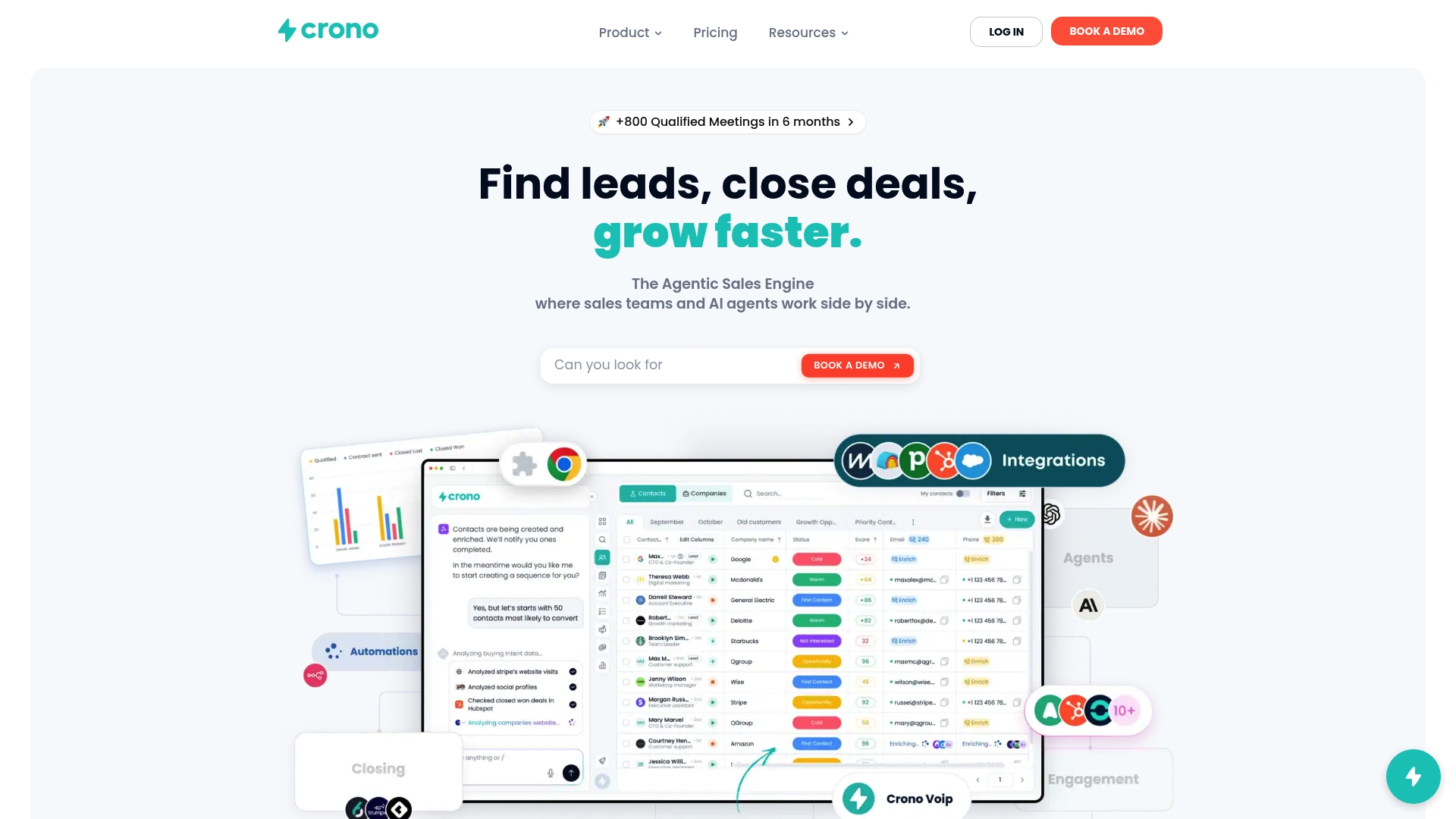
Crono is built for B2B revenue teams that need AI-powered sales execution without sacrificing data protection. As a sales execution layer, Crono connects your existing CRM and sales tools into a unified platform where AI agents and human reps work together, with human checkpoints built into every automated workflow. That architecture directly addresses Article 22 compliance. For sales leaders who want to run compliant B2B sales techniques at scale, Crono provides the orchestration layer that keeps automation fast and governance intact. If your team is evaluating privacy focused sales software that does not force a trade-off between speed and compliance, Crono is worth a close look.
FAQ
What is a GDPR compliant sales tool?
A GDPR compliant sales tool is software that enforces EU data protection requirements through technical controls, including consent management, automated data deletion, DSR processing, and audit trails, not just contractual commitments.
Is a signed DPA enough to make a sales tool GDPR compliant?
No. A signed DPA must be backed by technical controls like deletion APIs and data minimization processes. Liability persists if the vendor cannot demonstrate enforcement.
What does Schrems II mean for sales software?
Schrems II means that transferring prospect data to US-based servers creates a compliance risk that standard contractual clauses cannot fully resolve. EU-only data hosting is the most reliable mitigation.
How does GDPR Article 22 apply to AI sales tools?
Article 22 restricts fully automated decisions that significantly affect individuals. Sales tools using AI for lead scoring or outreach prioritization must include human review checkpoints to remain compliant.
How fast should a GDPR compliant tool fulfill a data subject request?
Leading solutions fulfill DSRs in under 10 minutes through automation across integrated systems. Manual fulfillment typically takes days and involves coordination across 26 people on average.
Leave a Reply