
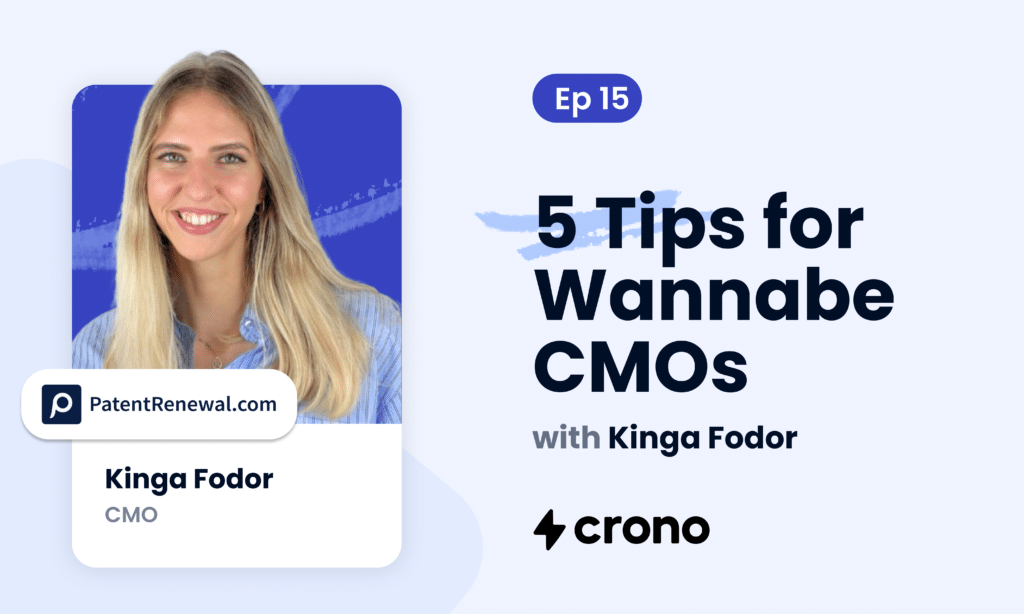
Welcome back to 5 Tips for Wannabe CMOs, our marketing column where we get to know great marketers, their stories and some inspiring tips for the next generation of CMOs.
In this episode we talked with Kinga Fodor, CMO at PatentRenewal.com, who started her career at Vodafone, Unilever and Henkel before finding her real home in B2B SaaS. Her journey took her from chasing millions of anonymous consumers to building a brand around one of the least glamorous categories in B2B: patent renewal fees.
Kinga shares why she’d rather build than maintain, how she went from expecting endless approval layers to hearing “sure, why not try it,” and what it actually takes to grow into a CMO role, from understanding the business behind the metrics to building a team you’d happily be outshined by. She also busts the biggest myth about the job: that it’s mostly about creativity.
Let’s dive in.
1. Let's start with your story. You began in B2C and found your real passion in B2B SaaS. What's the moment, project or "click" that shaped you most as a marketing leader?
I actually started my career convinced that B2C was where I wanted to be. I worked with global brands at Vodafone, Unilever and Henkel, where I learned the fundamentals of marketing, like customer journeys, creative testing, segmentation and brand building. Then you quickly realise the market doesn’t care how much effort went into a campaign. It might have performed well, but knowing why it performed well is a completely different challenge. What I didn’t see at the time was just how difficult that is, because there are so many moving parts.
In consumer marketing you’re often trying to understand the behaviour of millions of anonymous customers. You know sales increased or decreased, but connecting that back to a specific campaign is rarely straightforward. Was it the TV campaign? Social media? Retail activation? Pricing? Seasonality? Competitor marketing? It often takes extensive research before you can confidently explain why something happened.
The first shift came when I moved to the UK and worked for a startup incubator. That was my first exposure to founders and early-stage companies, and it reshaped how I thought about building businesses. Instead of spending months debating ideas, people would launch something, measure it, learn from it and move on. It wasn’t that they had fewer constraints, they just accepted that not every decision had to be perfect before taking action.
That mindset became even clearer when I joined PatentRenewal.com, a B2B SaaS scale-up based in Denmark. I still remember one of my first marketing brainstorming sessions. I came in with a long list of growth ideas, expecting to hear all the reasons they wouldn’t work. My previous experience had taught me that every new initiative came with layers of approvals, planning meetings, legal reviews, budget constraints, competing priorities, and months before anything actually reached the market. Instead, here the response was simply, “Sure, why not try it?” That single meeting completely changed how I viewed marketing.
I discovered that I enjoy building far more than maintaining. We could plan and launch a campaign, experiment within days, monitor performance almost immediately, and make decisions based on real data instead of assumptions. Yes, everything is smaller than at a multinational. But I’ve never had more ideas than I do now, and I think that’s because ideas actually go somewhere here.
Since everything we do is digital, I can finally see what worked and what didn’t. Attribution is much clearer, and we can get real customer behaviour data to guide our decisions rather than just guessing. Now I know exactly who our customers are. I regularly speak with our sales team about prospects, objections, lost deals, and the reasons why customers choose us and use those conversations to shape our messaging, positioning, content, and even parts of our product marketing. Marketing stopped feeling like a separate department and became part of solving customer problems.
Then there’s the part nobody expects. I ended up marketing in the IP industry, with patent renewals. Nobody wakes up excited about renewal fees, and when I tell people what I do, I can almost see them searching for a more interesting topic.
But in hindsight, that has probably been the most valuable part of my journey. When you’re marketing a product that people already love, the product often does a lot of the work for you. When you’re marketing something people don’t naturally care about, you have nowhere to hide. You have to understand the customer so well that you can connect an administrative process to the business outcomes they actually care about, whether that’s cutting costs, reducing risk, or saving their team time. At the same time, you have to build a brand that people actually trust and remember in an industry where most companies have been operating for decades. Finding ways to make a traditional, often overlooked category feel modern, approachable and unique has been one of the most rewarding creative challenges I’ve taken on.
That’s probably the biggest “click” in my career. I stopped thinking that great marketing is about making exciting products look exciting. Great marketing is about deeply understanding your audience and making the value obvious, even when the product itself isn’t glamorous.
2. If you had to give just 5 practical tips to wannabe CMOs who want to stand out and grow into the role - especially in B2B Saas - what would they be?
There are plenty of articles telling you to be data-driven, customer-centric, or to work closely with sales. I completely agree with all of that, but I’d consider those the basics for any marketing leader. The lessons that have had the biggest impact on my own journey are a little different.
3. Your 5 tips for wannabe CMOs: where should someone start if they dream of reaching your level?
One of the biggest shifts happened when I stopped thinking of myself as “the marketing person” and started thinking about the business as a whole. A CMO isn’t just responsible for generating leads, they’re responsible for helping the company grow. That means understanding sales, finance, pricing, customer success, product, and how all those functions fit together.
Of course, you have to be fluent in your marketing data. Every campaign, paid ad, SEO initiative, event, email, or website update should be measured and analysed so you know what’s driving results and what isn’t. But your overall business numbers matter just as much. You don’t have to become a finance expert, but you should understand how the business makes money, how marketing contributes to revenue, and where it fits in. Once you see that bigger picture, you stop optimising for marketing metrics alone and start thinking more about business outcomes.
Second, don’t let that make you allergic to the things you can’t measure. In B2B SaaS it’s tempting to pour everything into attributable leads, but some of the most valuable work like building a brand people trust and being the name they already know when they finally start looking, rarely shows up cleanly in a dashboard. The best marketing leaders keep investing in it anyway.
I’d encourage aspiring CMOs to become exceptional generalists before becoming specialists. Early on, I said yes to almost everything: content, SEO, paid ads, events, social media, email marketing, automation, websites, product marketing, branding, analytics… not because I wanted to become an expert in every area, but because it taught me how everything connects. That perspective has been more valuable than becoming an expert in any single channel.
You don’t need to be the best at every discipline, but you should understand enough to ask the right questions and recognise great work when you see it.
As you move into leadership, there’s a temptation to step away from execution and focus purely on strategy, but that’s not really realistic at a scale-up. I’m still very much involved in the work itself and help my team as much as I can. I enjoy brainstorming campaigns, writing copy, reviewing landing pages, experimenting with AI tools, and digging into campaign performance. It helps me make better decisions, but it also keeps me connected to what my team is actually working on every day.
3. Build a teamthat’s better than you.
That connects me to my next tip. One of the biggest surprises about becoming a CMO was realising that my own marketing skills became less important over time. My success is now largely determined by the people around me. I don’t want to hire copies of myself. I want specialists who are better than I am at SEO, paid media, design, analytics or marketing operations, then give them ownership and trust them to make decisions.
I really believe that a big part of the job is creating an environment where good people can do their best work.
I don’t think a CMO should have all the best ideas. In fact, I’d much rather be surrounded by people who constantly challenge my thinking and come up with ideas I wouldn’t have had myself.
Moving from multinationals into startups completely changed the way I think about execution. Back then, every campaign went through countless approvals, planning meetings, reviews and revisions before it ever reached a customer. In a startup, I learned that speed is often a competitive advantage.
That doesn’t mean being careless. It means accepting that you rarely have perfect information. I’d much rather launch something that’s 80% ready, learn from real customers, and improve it than spend months trying to predict what might happen. Looking back, many of our best-performing campaigns, website improvements, or product initiatives started as small experiments rather than fully polished strategies. I’ve found that you usually learn more from launching than from another month of planning.
Every year, marketing feels like a different job. It looks completely different today than it did even a few years ago. AI, search, content, attribution, buyer behaviour, new channels… everything evolves almost every week.
The people who stand out aren’t necessarily the smartest, they’re the ones who keep learning. I still spend a lot of time reading, testing new tools, joining webinars, listening to podcasts, and experimenting with ideas that may never work, but always asking, “What if we tried it differently?” Curiosity has been the best investment I’ve made in my career. It’s kept marketing fun, but it’s also helped me spot opportunities much earlier than I otherwise would have.
One piece of advice specifically for right now: get genuinely fluent in AI. Not “I write prompts” fluent, but actually build it into how you work with AI agents. Using it for research, brainstorming, drafts, campaign ideas and performance reviews has become standard, but the real shift has been moving from treating AI as a chatbot I ask questions to using agents that actually do the work. Instead of pasting numbers into a chat, I can connect a tool like Claude to our own stack and hand it a whole task: pull the data, analyse what’s working, and draft the report. Building AI agents for the repetitive things has made me far more efficient, and freed up the team to spend less time on mechanical work and more on thinking. The gap I see opening isn’t between people who use AI and people who don’t, but between those who’ve made it part of how they work every day and those who still treat it as a novelty.
3. What's one thing about being a senior marketing leader in B2B SaaS that most people wouldn't expect or a "myth" you'd love to bust once and for all?
One myth I’d love to bust is that marketing leadership is mostly about creativity. People often imagine that a CMO spends the day coming up with campaign ideas, reviewing designs, approving ads, or writing catchy taglines. I still genuinely enjoy those parts of the job and stay very involved in them. I love brainstorming with the team, reviewing copy, discussing landing pages, testing new AI tools, and thinking about how we can communicate something more clearly.
What many people don’t see is everything that happens around those creative moments. Before a campaign even exists, there are discussions about business priorities, target markets, budgets, product positioning, expected ROI, timelines, resources, and whether it’s the right initiative to focus on in the first place. Once it’s launched, the work doesn’t stop. That’s when you start looking at the numbers, analysing what worked and what didn’t, speaking with sales, collecting customer feedback, and deciding what to improve in the next iteration.
Sure, the creative work gets the attention, but it’s often just the most visible part. What really determines a campaign’s success is everything happening behind the scenes, from the planning beforehand to the analysis and improvements afterwards.
4. To close, what would you tell the younger version of yourself trying to figure it all out?
I think I’d tell myself to worry less about having all the answers and spend more time being curious. Early on, I often felt like everyone else knew more than I did. Looking back, I don’t think that was ever true. The people who grew the fastest weren’t necessarily the most experienced; they were the ones who kept asking questions, trying new things, and admitting when they didn’t know something.
I’d remind myself that it’s perfectly okay to change your mind about what you enjoy. I was convinced I’d only ever want to work on big consumer brands. If someone had told me I’d end up loving B2B SaaS and legal tech, I wouldn’t have believed them. But I’ve learned that it’s rarely the industry that makes a job exciting: it’s the people, the challenges, and the opportunity to build something meaningful.
Finally, I’d tell myself to trust that I’ll figure it out. Throughout my career, I’ve taken on projects and roles that felt just a little bigger than my experience at the time. None of them felt comfortable on day one, but that’s exactly why they were worth taking. Looking back, I don’t remember the moments when I felt ready, I remember the moments when I decided to try anyway.
Not sure where to start?
Start with the Playbook.
Download our free Sales Playbook 2026 and learn how top B2B teams structure their outbound process.
 BANT, SPICED & MEDDPICC frameworks
- 30+ ready-to-use sales templates
- 2026 outbound & pipeline benchmarks
Don't sell the product. Sell the change the product makes possible.
Build the process before the pipeline.
Start your sales revolution
Join 300+ sales teams using Crono and change your sales game.
