
Use a 4 to 7 word, sentence case statement built around a company or event signal, and measure results by reply rate, not open rate. Open-rate data is compromised by Apple Mail Privacy Protection and similar prefetchers, which register phantom opens on emails no one actually read. Test one template against your current baseline for two weeks, holding sender, body, and send time constant.
TL;DR:
- Subject lines between 4 and 7 words increase reply rates by 12 to 18 percent, especially when formatted in sentence case.
- Personalization via company signals and signals linked to actual events outperforms first-name merges and generic curiosity hooks.
- Infrastructure factors such as sender reputation and list hygiene are more critical for inbox delivery than wording or format.
- Testing should involve holding variables constant and requiring sufficient volume to identify meaningful reply rate differences.
- Industry-specific signals and psychological triggers like loss aversion and specific relevance significantly boost response likelihood.
Table of Contents
- What the Data Says About B2B Subject Lines That Get Replies
- Templates and Categorized Subject Line Examples
- How Should You Test and Measure Subject Line Performance?
- Personalization and Signal Sourcing: What to Prioritize
- Deliverability and Spam Triggers Worth Avoiding
- When Should You Send Each Subject Line Type?
- A Quick Checklist for Writing Subject Lines That Earn Replies
- How Sales Execution Platforms Operationalize Signal-Based Subject Lines
- Industry-Specific Subject Line Strategies
- Psychological Triggers That Work in B2B Subject Lines
- Three Priorities I’d Fix First
- Scale Signal-Based Subject Lines Without the Manual Research
- Sources
What the Data Says About B2B Subject Lines That Get Replies
Length matters more than most sales teams assume. Operator datasets show subject lines running 4 to 7 words lift reply rates 12 to 18% over both shorter and longer alternatives. That band reads like a real person wrote it in ten seconds between calls, not like a template pulled from a sequencer. Below 4 words, the line often looks vague or robotic. Above 7, it starts resembling a marketing subject, and B2B buyers have been trained by their inboxes to distrust that shape.
Personalization has a hierarchy, and most teams get it backwards. First-name merges feel personal but rarely move the needle, because every marketing email already does it. Company-name personalization performs better on its own, and company name paired with a specific signal outperforms both, lifting reply rates by 11 to 15% over generic openers. A line like “Acme and your Series B” tells the recipient this email required actual research, not a mail merge field.
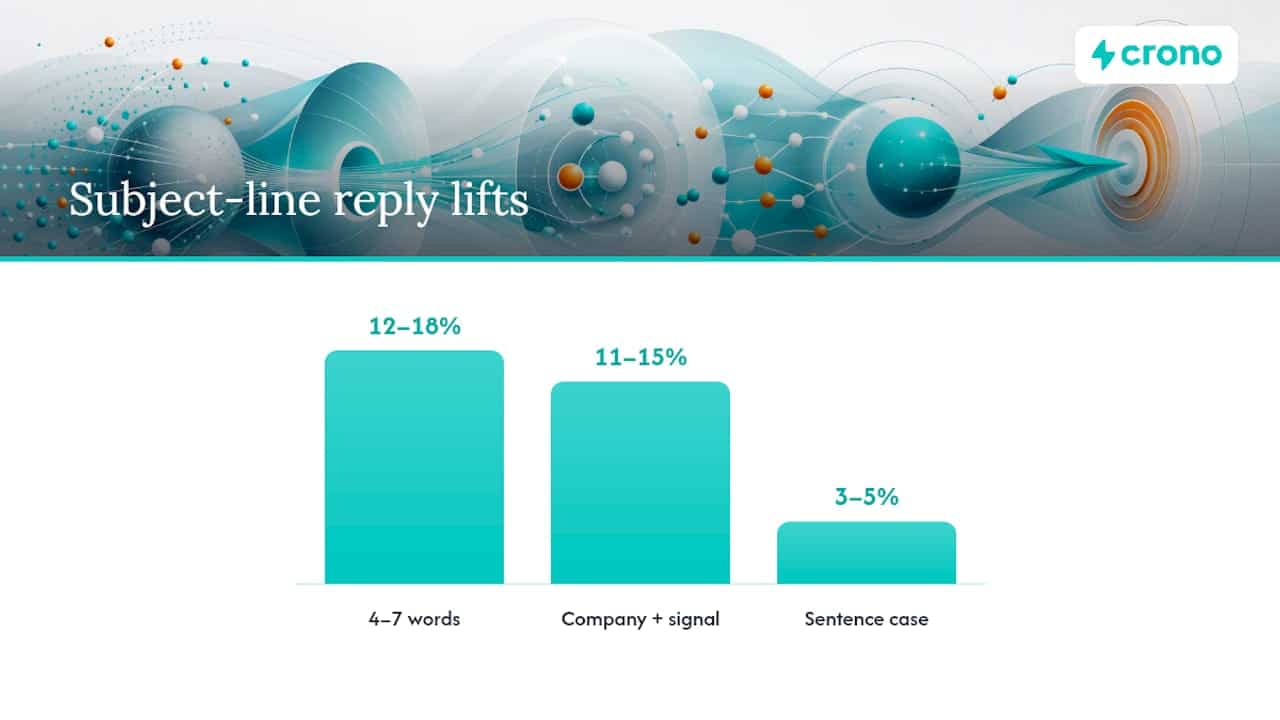
Formatting sends a signal before a single word is read. Title Case And ALL CAPS both read as marketing, and marketing gets deleted faster than a peer message does. This is a small effect on any single email, but it compounds across a sequence sent to hundreds of contacts.
Questions are trickier than the conventional wisdom suggests. A question mark can raise opens by creating curiosity, but it frequently lowers reply rates because it invites a mental “later” instead of an immediate response. Reserve questions for cases where the question is laser specific to something the prospect actually did, like a product change or a hire. Otherwise, default to a statement. Statements read as confident and informed; vague questions read as filler.
None of this outranks the fundamentals. Subject-line optimization is a multiplier, not a fix. Sender reputation, domain warm-up, and list relevance determine whether an email lands in the inbox at all, and these upstream factors matter more than the wording of any single line. A perfect subject line on a cold, unwarmed domain sent to a stale list still fails.
What the research consistently shows:
- 4 to 7 words lifts reply rate 12 to 18% over other length bands
- Company plus signal personalization lifts reply rate 11 to 15% over first-name-only merges
- Sentence case adds a 3 to 5% reply-rate lift over title case
- Questions can raise opens but often suppress replies unless hyper-specific
- List quality and sender reputation still outweigh subject-line wording
Templates and Categorized Subject Line Examples
Every category below solves a different job in the sequence. Cold outreach needs to prove relevance in one glance. Follow-ups need to remind without repeating. Expansion emails need to quantify a win. Breakup emails need to close the loop without sounding desperate.
1. Signal-based cold outreach
Signals do the personalization work that clever copy can’t fake. Operator reports consistently show signal-anchored lines beating generic curiosity hooks, because a hiring spree or a funding round is objective proof you did homework, not a guess dressed up as insight.
- “{{company}} hiring 3 SDRs”
- “Saw the Series A, {{company}}”
- “{{company}}’s new VP of sales”
- “Quick note on {{company}}’s stack”
- “{{company}} and your Q3 push”
2. Follow-up subject lines
Follow-ups should reference the specific thing your first message promised, not restate that you’re “following up.” Referencing the original offer signals continuity and respects the prospect’s memory instead of testing it.
- “The ROI number from last week”
- “Still relevant for {{company}}?”
- “One thing I forgot to mention”
- “The case study I mentioned”
3. Nurture and expansion subject lines
For existing contacts or upsell motions, quantify the benefit or point at a milestone that just happened. Vague check-ins get ignored; specific numbers get opened.
- “3 accounts hit their limit this month”
- “{{metric}} since your last renewal”
- “A faster way to run {{workflow}}”
4. Breakup and close-the-loop subject lines
Breakup emails close a thread cleanly and sometimes trigger a reply purely from loss aversion. Use them after 3 to 5 unanswered touches, not after one silent email.
- “Closing the loop, {{first_name}}”
- “Should I stop reaching out?”
- “Wrong priority for {{company}} right now?”
Tokenization needs guardrails or it backfires publicly. Test every merge field ({{company}}, {{metric}}, {{event}}) against a sample of real records before a Sand, and build fallback text for any record missing that field. A subject line reading “{{company}} hiring 3 SDRs” with a blank merge field is worse than no personalization at all. Review cold outreach strategies and the cold email template for B2B software companies for structures that pair subject lines with matching body copy.
How Should You Test and Measure Subject Line Performance?
Open rate is no longer a trustworthy scoreboard. Apple Mail Privacy Protection and corporate scanning tools prefetch messages automatically, registering an “open” whether or not a human ever saw the email. Reply rate, meetings booked, and positive-sentiment responses are the metrics that reflect what a subject line actually did.
Run tests correctly or the results mean nothing. Common testing rules call for:
- Holding sender, body copy, and send time identical across variants
- Testing only within a matched persona and buyer stage, never mixing segments
- Running each test a minimum of 5 business days before reading results
- Requiring enough volume per variant that a handful of replies doesn’t decide the outcome
A test comparing 40 emails against 40 emails will produce noise, not a winner. Aim for enough volume per variant that a 2 to 3 point difference in reply rate is meaningful, not a coin flip.
Pro Tip: Keep a running swipe file tagged by persona, industry, and sequence step. When a subject line wins a test, log the exact wording, the segment, and the reply rate lift, then retire it after 90 days before it becomes overused within that list.
Personalization and Signal Sourcing: What to Prioritize
Company and event signals outperform first-name personalization in B2B, because company-level signals establish legitimacy faster than a name merge ever will. A prospect skims their inbox assuming most emails are automated; a signal referencing their actual funding round, a recent hire, or a tech stack change breaks that assumption in half a second.
Credible signals come from a short list of sources: funding announcements, job postings on the company’s own careers page, executive changes on LinkedIn, product launches, and technology adoption data from enrichment tools. A signal only counts if you can verify it against a primary source, not a guess based on company size or industry.
Scaling personalization safely means building verification into the workflow, not skipping it under deadline pressure:
- Enrich records with a reliable data source before generating any tokenized subject line
- Validate that every merge field returns real data across a sample before a full send
- Build fallback copy for records with missing or unverifiable fields
- Spot-check a random sample of generated subject lines before scheduling the send
The prospecting masterclass on outbound sales in B2B SaaS makes the case directly: relevance beats cleverness, and relevance requires real signal sourcing, not a first-name field pulled from a CRM export.
Deliverability and Spam Triggers Worth Avoiding
Wording choices still matter for deliverability, even though infrastructure does the heavy lifting. Avoid “free,” “act now,” excessive punctuation, dollar signs, brackets, and multiple emoji stacked in one line. These patterns trigger spam filters that have been trained on years of exactly that phrasing.
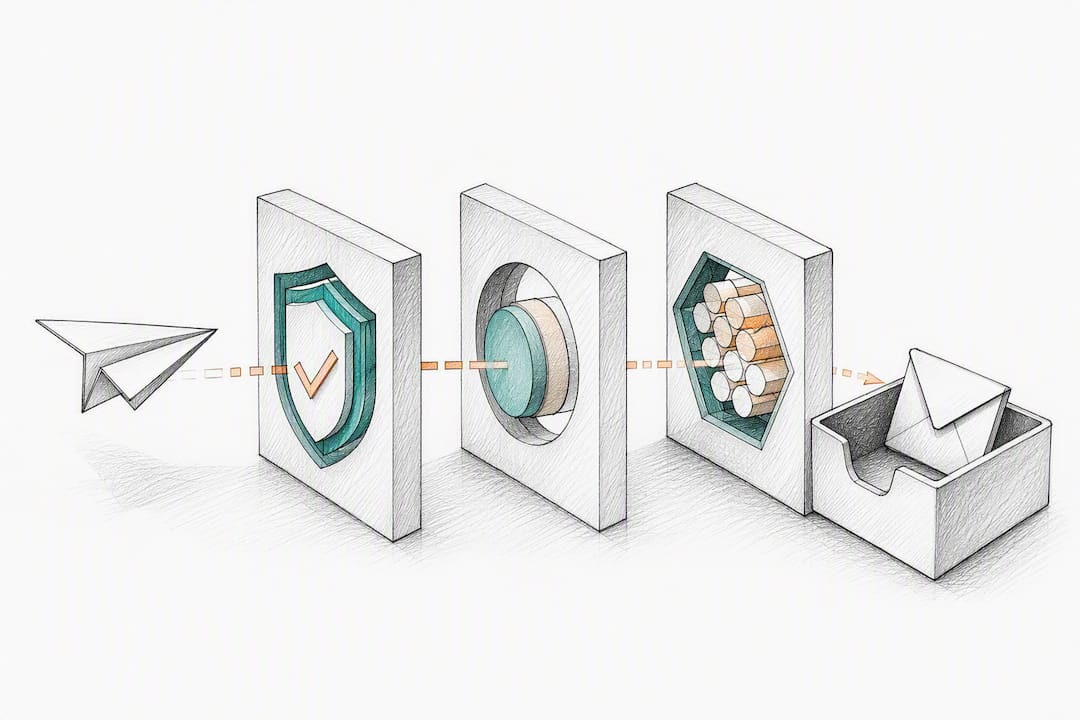
The bigger lever sits upstream of the subject line entirely. SPF, DKIM, and DMARC authentication, a proper domain warm-up period, and consistent list hygiene determine inbox placement far more than any word choice does. A clean, verified list sent from an authenticated domain will outperform a “perfect” subject line sent from a cold domain to a purchased list every time.
Preheader text should extend the subject line’s promise, not contradict it. If the subject references a signal, the first line of body copy needs to deliver on that reference immediately, or the recipient feels baited and marks it spam. Before sending, check how the line renders in a mobile preview and run it through a spam-word scanner, since most email opens now happen on mobile devices where truncation cuts subject lines short.
When Should You Send Each Subject Line Type?
Send timing interacts with subject-line format more than most teams realize. Operator data points to Tuesday between 10 a.m. and noon in the recipient’s local time zone as a consistently strong window for cold sends, though the lift over other weekday mornings is incremental rather than dramatic.
A basic five-touch sequence maps subject-line type to day:
- Day 1: signal-based opener (“{{company}} hiring 3 SDRs”)
- Day 3: new angle on the same signal, different benefit framing
- Day 5: follow-up referencing the original offer directly
- Day 8: defined, low-friction ask (“Worth 15 minutes?”)
- Day 12: breakup line closing the loop
Combine this cadence with signal freshness. A signal that’s 60 days old carries less weight than one from last week, so refresh your list’s signal data before each new sequence launch.
A Quick Checklist for Writing Subject Lines That Earn Replies
Four steps cover most of what separates a subject line that gets ignored from one that gets answered.
- Choose the signal. Pick the most specific, verifiable fact about the account: a funding round, a hire, a product change, or a measurable benefit tied to their business.
- Format as a 4 to 7 word sentence case statement. Skip title case, skip question marks unless the question is laser specific, and write it the way you’d text a colleague.
- Verify the tokens and align the preheader. Confirm every merge field resolves correctly on a sample, and make sure the first line of body copy delivers on the subject’s promise.
- Schedule, tag, and test. Log the variant, hold everything else constant, and read results by reply rate after a minimum 5 business day run.
Pro Tip: Before scheduling any batch send, pull 20 random records and manually read the generated subject lines out loud. If one sounds broken or robotic, the merge logic needs a fix before the whole list goes out.
How Sales Execution Platforms Operationalize Signal-Based Subject Lines
Manually verifying signals for every contact doesn’t scale past a few dozen accounts a week. Some sales execution platforms centralize buying signals, funding events, hiring activity, and technology changes, then enrich contact records so a subject line token pulls from verified data instead of a guess.
That structure turns the personalization hierarchy from the earlier section into something repeatable across a full pipeline rather than a handful of manually researched accounts:
- Signal aggregation flags account-level events automatically, so reps aren’t manually scanning LinkedIn for hires or funding news
- Enrichment fills in company and contact fields before any tokenized subject line generates, reducing broken merge fields
- Playbooks like the outbound sales in B2B SaaS masterclass and cadence timing resources translate signal data into sequence structure
- Reply-rate dashboards replace open-rate tracking as the primary success metric across sequences
The guardrail that matters most is token verification against a sample before a send goes live, paired with sender domain warm-up so the infrastructure underneath the subject line is actually sound.
Industry-Specific Subject Line Strategies
Tech buyers respond to specificity about their stack. A subject line referencing a specific tool, integration, or migration (“Your move off {{legacy_tool}}”) reads as informed rather than generic, because technical buyers filter aggressively on relevance.
Finance and financial services buyers tend to respond better to risk and compliance framing than growth framing. A line like “{{company}}’s Q4 audit prep” lands harder than a generic efficiency pitch, because compliance deadlines create urgency that growth language doesn’t.
Manufacturing and industrial buyers often respond to operational specificity: downtime, throughput, or supply chain events. “{{company}}’s new supplier shift” or referencing a plant expansion signals the sender understands the operational reality, not just the org chart.
Across all three, the same underlying rule holds: swap the generic signal for the one that matches how that industry actually measures pressure. A tech buyer thinks in stack and velocity. A finance buyer thinks in risk and deadlines. A manufacturing buyer thinks in output and supply. Match the signal to the vocabulary the recipient already uses internally, and the subject line reads as insider knowledge rather than outreach.
Psychological Triggers That Work in B2B Subject Lines
Loss aversion outperforms gain framing more often than sales teams expect. A line implying a missed opportunity (“Should I stop reaching out?”) frequently pulls a reply where a purely positive pitch gets silence, because people respond faster to avoid losing something than to gain something equivalent.
Specificity itself functions as a trust signal. A vague claim (“boost your sales”) reads as mass-produced. A specific number, name, or event (“{{company}} hiring 3 SDRs”) reads as researched, and research implies the sender respects the recipient’s time enough to have done it.
Reciprocity shows up in follow-up sequences that reference something given, not just asked for. A subject line pointing back at a resource, case study, or insight shared earlier primes the recipient to feel a small obligation to respond, rather than facing a cold ask with nothing offered first.
Urgency works only when it’s real. Manufactured urgency (“Last chance!”) reads as manipulative in a B2B context and damages trust with a buyer who will remember the tactic. Urgency tied to an actual event, deadline, or limited capacity performs because it’s verifiable, not because it’s loud.
Finally, curiosity has a ceiling in B2B that it doesn’t have in consumer marketing. A curiosity gap can raise opens, but a B2B buyer evaluating a purchase decision responds better to clarity about value than to mystery about what’s inside the email.
Three Priorities I’d Fix First
If I had to rank what actually moves reply rates, infrastructure comes first. Fix sender reputation, authentication, and list hygiene before touching a single word of subject-line copy, because no formatting trick survives a domain that’s already flagged.
Second, adopt signal-first, 4 to 7 word sentence case templates as the default for cold outreach, not an occasional experiment. Third, retire open rate as your primary success metric and measure by reply rate, segmented by persona and sequence stage. Most teams get this backwards: they obsess over clever wording while ignoring the warm-up period on a new sending domain. Wording is the multiplier. Infrastructure is the number it’s multiplying.
Scale Signal-Based Subject Lines Without the Manual Research
Everything in this playbook works better with less manual effort behind it. Some platforms centralize the buying signals, enrichment, and cadence automation that make signal-based subject lines possible at volume, instead of leaving reps to research funding rounds and hiring pages one account at a time.
Some platforms pull account signals and enrich contact records automatically, so tokens like {{company}} and event references resolve against verified data rather than a guess. Cadence templates can map subject-line types to sequence steps similar to this article’s blueprint, and reply-rate dashboards may replace open-rate tracking as the metric that actually decides whether a template works. For a deeper look at building the sequences these subject lines plug into, the prospecting masterclass walks through the full framework. If you’re ready to see the signal aggregation and automation in action, book a demo with Crono and test it against your current sequence for two weeks.
Sources
- Apple Mail Privacy Protection: how email senders should adapt | Twilio
- B2B Email Subject Lines That Convert (Measured by Reply Rate, Not Open Rate) | Outsolvi
- The B2B email guide to subject-line variation | Autobound
- 150+ Sales Email Subject Lines That Get Opened, Read, and Responded To | HubSpot
