
An AI-assisted sales playbook is a rep-facing intelligent assistant built on approved sales content that delivers real-time, stage-specific guidance at every point in the deal cycle. Unlike a static PDF or shared Google Doc, this format responds to deal context, generates talk tracks on demand, and surfaces the right objection handler before a rep even asks.
B2B sales leaders who want to build an AI-assisted sales playbook are moving from documentation to execution. The result is faster onboarding, more consistent messaging, and measurably better win rates across the entire team.
What foundational components do you need to build an AI-assisted sales playbook?
The core of any effective AI sales playbook is structured, modular content that an AI agent can actually use. Stage-specific frameworks include stage objectives, entry and exit criteria, your ideal customer profile (ICP), discovery questions, demo flows, pricing motions, and objection responses. Without this structure, AI agents return generic advice that reps ignore after the first week.
Start with your ICP definition. Document firmographic and behavioral signals that qualify a prospect, and write them in plain language. AI assistants trained on vague ICP descriptions produce vague recommendations. Specificity at this stage determines the quality of every output downstream.

Messaging comes next. Capture your core value proposition by persona, your differentiation from alternatives, and the language your best reps actually use on calls. The goal is to give the AI assistant approved vocabulary, not a blank canvas. Team validation of AI-drafted content is what separates a playbook reps trust from one they quietly ignore.
Keep the core playbook concise, under 15 pages, and attach detailed assets separately. Battle cards, email scripts, and call guides live as on-demand modules rather than embedded walls of text. This structure lets AI assistants pull the right asset for the right stage without overwhelming the rep.
- ICP and qualification criteria: Define firmographics, buying signals, and disqualifying factors in plain language.
- Sales stage map: Document objectives, entry criteria, exit criteria, and required actions for each stage.
- Messaging by persona: Write value propositions and differentiation points for each buyer role.
- Objection library: Capture the top objections by stage with approved responses from your best reps.
- Detachable assets: Battle cards, talk tracks, email templates, and demo scripts as separate, linkable modules.
Pro Tip: Define the AI assistant’s job, its source material, its inputs, and its expected outputs before you write a single prompt. Clear assistant definitions produce consistent outputs. Skipping this step is the single most common reason AI playbooks fail in the first 60 days.
A week-by-week build schedule works well in practice. Week one covers ICP, messaging, and sales process. Week two handles objections and battle cards. Week three produces email and call scripts. Week four is review and rollout. This cadence keeps the project moving without sacrificing quality.
How do you integrate AI sales playbooks into your existing sales stack?
Integration is where most digital sales playbook projects stall. The architecture that works best connects your CRM data to an AI agent layer, then surfaces outputs directly inside the tools reps already use.
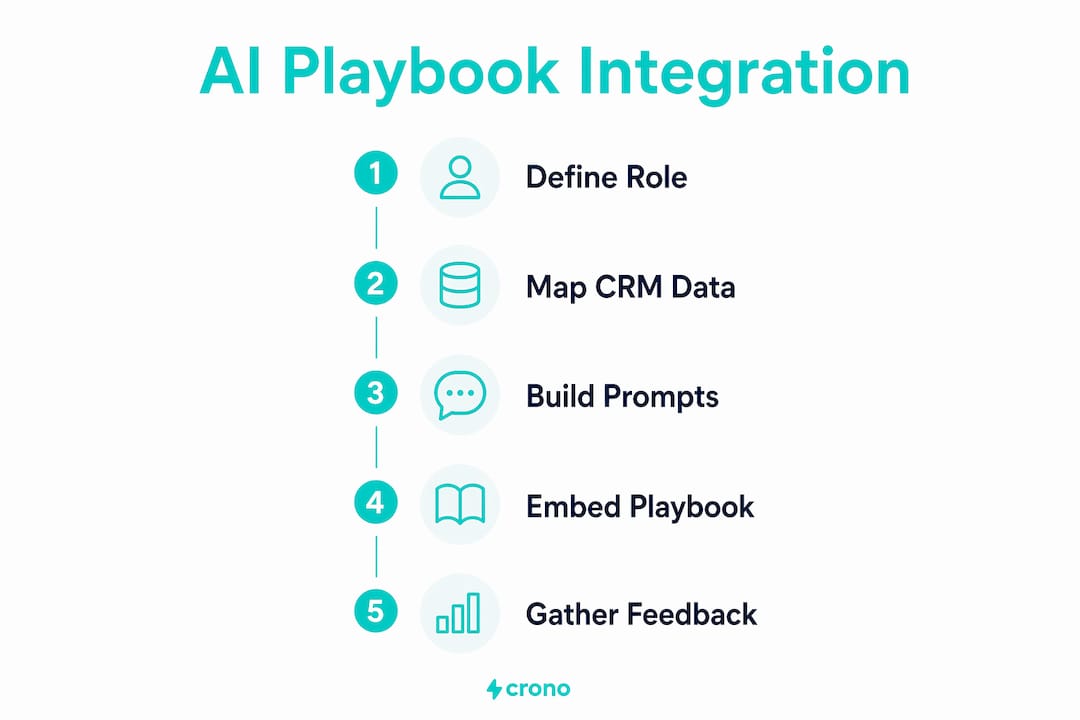
The reference architecture used by leading B2B teams combines Salesforce Einstein for deal data and scoring with AI agents like Claude or GPT-based assistants for content generation. Trigger-based agents fire when a deal changes stage, when a score drops, or when a rep logs a specific activity. The agent reads the deal context, matches it to the relevant playbook section, and pushes a recommendation to the rep via Slack or a CRM sidebar.
| Trigger event | AI agent action | Rep-facing output |
|---|---|---|
| Deal moves to demo stage | Pull demo flow and persona messaging | Talk track in CRM sidebar |
| Opportunity score drops 20+ points | Analyze deal gaps against stage criteria | Risk alert with suggested next steps |
| Rep logs a competitor mention | Surface relevant battle card | Objection handler in Slack |
| Deal stalls for 14+ days | Review last activity and stage criteria | Re-engagement email draft |
Prompt templates are the operational backbone of this system. Each stage in your sales process needs a corresponding prompt that tells the AI what context to read, what playbook section to reference, and what format to return. Without stage-specific prompts, the AI agent produces outputs that are technically correct but contextually useless.
Pro Tip: Build guardrails into every prompt template. Specify what the AI should not do, such as inventing pricing, making promises outside approved messaging, or referencing competitors by name. Guardrails for consistent output protect your brand and keep reps from having to second-guess AI recommendations.
Embedding guidance directly inside the tools reps use is non-negotiable for adoption. Playbooks embedded in CRMs or sales engagement platforms prevent context switching, which is the primary reason reps abandon external playbook tools. Link each play to the exact action or asset required at that moment, not to a folder or a separate document library. You can see real examples of this approach in agentic sales execution across B2B teams.
What best practices drive adoption, trust, and continuous improvement?
Adoption fails when reps see the AI playbook as a compliance tool rather than a performance tool. The fix is measurement tied to outcomes they care about.
Metrics for AI playbook effectiveness connect to revenue, productivity, forecast accuracy, and AI error rates. Review these in a regular operating cadence: biweekly for error rates and rep feedback, monthly for productivity signals, and quarterly for revenue and forecast impact. Use control groups where possible to isolate the playbook’s contribution from other variables.
- Set outcome-linked KPIs. Tie playbook metrics to win rate, ramp time, pipeline coverage, and forecast accuracy. Avoid vanity metrics like page views or logins.
- Run a biweekly review cadence. Check AI error rates, rep feedback, and flagged outputs every two weeks. Fix prompt issues before they erode trust.
- Update from real deal data. Call transcripts, win/loss data, and manager notes are your best sources for playbook updates. Quarterly refreshes prevent the playbook from becoming stale.
- Start narrow if your CRM data is incomplete. Narrowly defined use cases like cross-sell or upsell scenarios generate measurable wins faster than broad deployments. Early wins build rep confidence.
- Capture top-performer behavior explicitly. Record how your best reps handle specific objections, run discovery, and close. Feed this into the playbook as approved guidance, not as anecdote.
“AI accelerates playbook content creation, but team validation ensures authenticity and rep trust, preventing generic or unusable sales guidance.” — Aimadefor AI Sales Playbook Guide
The AI in B2B revenue teams framework from Crono reinforces this point: feedback loops between rep activity, deal outcomes, and playbook content are what separate a living AI playbook from a document that collects dust.
What are the most common pitfalls when building AI-assisted sales playbooks?
Most AI playbook projects fail for predictable reasons. Knowing them in advance saves months of rework.
- Skipping team validation. AI drafts playbook content quickly, but content that has not been reviewed by experienced reps produces outputs that feel off. Reps stop using tools they do not trust. Build a validation step into every content sprint.
- Building a playbook that is too long. A 60-page playbook is not a playbook. It is a reference library. AI assistants trained on dense, unstructured documents return inconsistent outputs. Keep the core document under 15 pages and modularize everything else.
- Undefined assistant jobs. Deploying an AI agent without specifying its job, source material, and output format produces unpredictable results. Every assistant needs a clear definition before it goes live.
- Ignoring trigger design. An AI playbook that reps have to manually activate is just a search engine. Design trigger conditions, such as stage changes, score drops, or competitor mentions, so guidance arrives without the rep having to ask.
- Storing playbooks outside the sales stack. Reps do not leave their CRM to read a document. Guidance embedded at the point of need drives adoption. Guidance stored in a shared folder does not.
- Launching without a dependency check. A revenue intelligence dependency review before activation catches broken data connections and missing signal sources that would otherwise make AI recommendations functionally wrong from day one.
The pattern across failed deployments is the same: teams treat the AI playbook as a content project rather than a systems project. Content is the input. The system, including triggers, prompts, integrations, and feedback loops, is what makes it work.
Key Takeaways
An AI-assisted sales playbook works when structured content, precise AI assistant definitions, and CRM-embedded triggers operate as a single system rather than separate projects.
| Point | Details |
|---|---|
| Structure content modularly | Keep the core playbook under 15 pages and attach battle cards, scripts, and objection handlers as separate assets. |
| Define every AI assistant precisely | Specify the assistant’s job, source material, inputs, outputs, and guardrails before writing any prompt. |
| Embed guidance in the sales stack | Place AI recommendations inside CRM sidebars or Slack, not in external documents, to drive rep adoption. |
| Measure outcomes, not activity | Track win rate, ramp time, and forecast accuracy rather than logins or page views. |
| Update quarterly from real deal data | Use call transcripts, win/loss analysis, and manager notes to keep playbook content accurate and trusted. |
Why most AI playbook projects miss the point
After working with B2B sales teams on AI-driven sales process design, the pattern I see most often is this: teams spend 80% of their effort on content and 20% on the system that delivers it. Then they wonder why reps are not using the playbook.
The content matters, but it is not the hard part. The hard part is designing the triggers, the prompt templates, and the feedback loops that make the AI assistant feel like a knowledgeable colleague rather than a search bar. When I see a team capture top-performer behavior and encode it into stage-specific prompts connected to real CRM signals, adoption follows naturally. Reps do not resist tools that make them better at their jobs.
The risk I worry about most is generic AI content replacing the unique knowledge your best reps have built over years. AI accelerates creation, but if you skip the validation step, you end up with a playbook that sounds plausible and performs poorly. The teams that get this right treat validation as a non-negotiable sprint, not an optional review. They also start narrow. One use case, one stage, one persona. Prove it works, measure the outcome, then expand. That approach builds the rep trust that makes everything else possible. For teams looking to go deeper on the technical side, the AI tools for sales coaching guide covers the tooling layer in detail.
How Crono helps B2B teams put AI playbooks into action
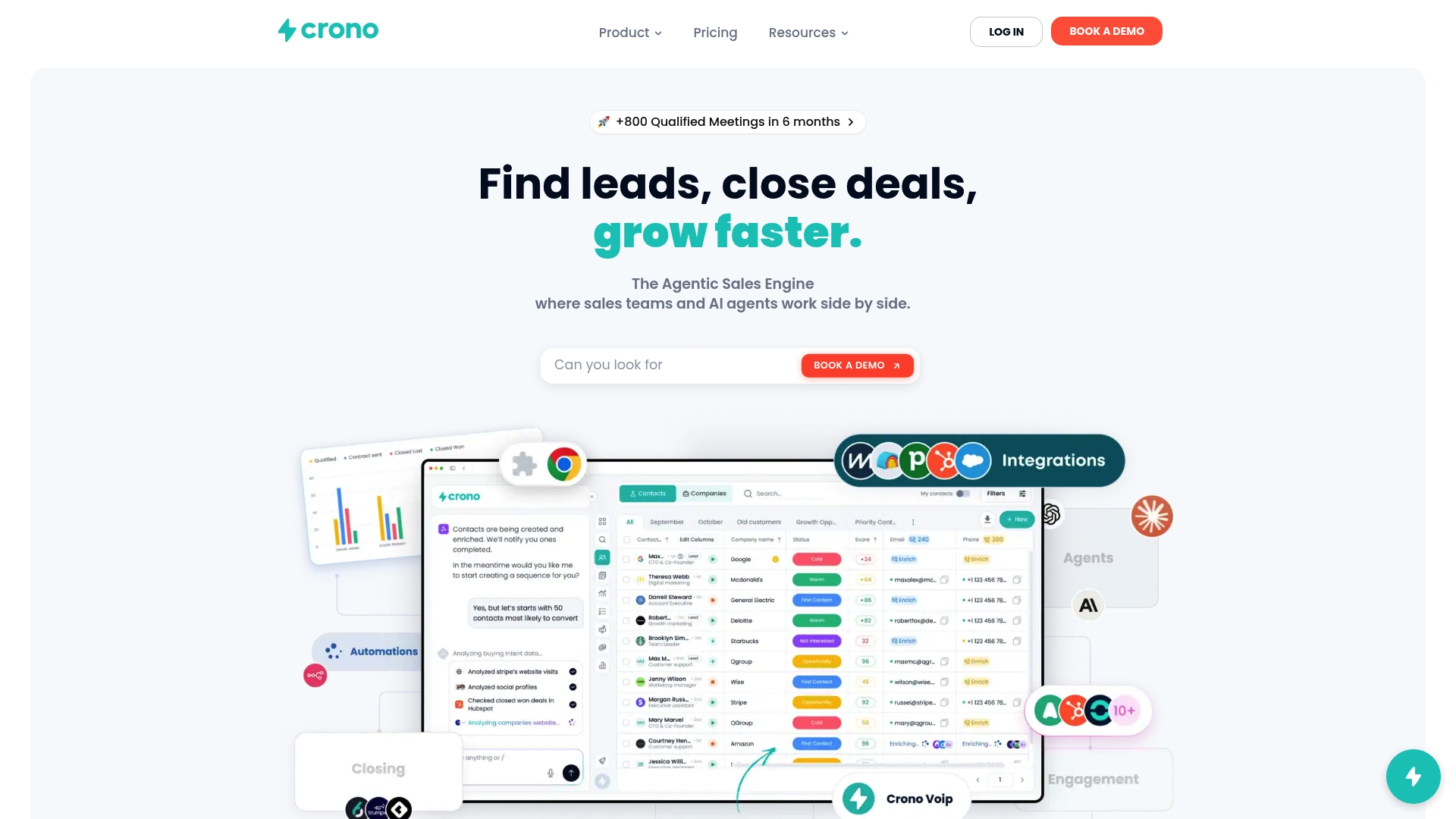
Crono is built for exactly this kind of deployment. As an Agentic Sales Engine, Crono connects signals, CRM data, and sales context to AI agents that work alongside your reps in real time.
If you are ready to move from a static playbook to a live AI-driven sales process, Crono’s guide on deploying AI sales agents walks through the full architecture, from trigger design to rep-facing output. For teams focused on alignment and adoption, the sales team AI agents guide covers how to embed AI assistants into existing workflows without disrupting what already works. Both resources are built for B2B revenue teams that want measurable results, not another tool to manage.
FAQ
What is an AI-assisted sales playbook?
An AI-assisted sales playbook is a rep-facing intelligent assistant built on approved sales content that delivers real-time, stage-specific guidance. It replaces static documents with dynamic outputs like talk tracks, objection handlers, and email drafts triggered by deal context.
How long should a sales playbook be for AI use?
The core playbook should stay under 15 pages. Detailed assets like battle cards and call scripts attach as separate modules that AI assistants pull on demand.
What CRM integrations work best for AI sales playbooks?
Salesforce Einstein combined with AI agents like Claude or GPT-based assistants is a proven reference architecture. Trigger-based agents connected to stage changes and score drops push recommendations directly to reps via Slack or CRM sidebars.
How often should you update an AI sales playbook?
Quarterly updates driven by call transcripts, win/loss data, and manager notes keep the playbook accurate. Error rates and rep feedback warrant a biweekly review cadence.
Can you build an AI sales playbook with incomplete CRM data?
Yes. Start with narrow use cases like cross-sell or upsell scenarios where actionable signals already exist. Early wins build confidence and give you cleaner data to expand from.
