
Sales enablement is the discipline of equipping sellers with the content, training, coaching, and technology they need to engage buyers effectively at every stage of the deal cycle — with the modern emphasis firmly on reducing seller drag and improving the seller experience through AI-driven execution.
TL;DR for busy leaders:
- Teams that treat enablement as an ongoing execution layer, not a one-time training event, see measurable gains in win rate, ramp time, and rep retention.
- AI-driven platforms that integrate directly with your CRM reduce the manual overhead that pulls reps away from selling.
- The recommended next step: audit seller drag in your current workflow, then run a focused 90-day pilot with a defined cohort and clear KPIs.
Table of Contents
- What does modern sales enablement actually look like?
- What are the core components of a modern enablement program?
- How does AI change sales execution for your team?
- What KPIs actually prove sales enablement impact?
- How should you evaluate AI-driven sales execution platforms?
- What does a 90-day implementation roadmap look like?
- What pitfalls sink most enablement pilots?
- Key Takeaways
- Where is the sales enablement category heading?
- Crono brings the execution layer to your enablement program
- Useful sources and further reading
What does modern sales enablement actually look like?
Gartner recommends shifting the focus from seller skills alone to improving the seller experience, with seller drag — the friction created by disconnected tools, manual handoffs, and redundant admin — identified as the primary barrier to productivity. That framing changes everything about how you design a program.
Modern enablement is not a training calendar. It is a continuous operating model where Sales and Marketing share ownership: marketing supplies content and messaging, while sales feeds back buyer engagement signals that sharpen what gets created next. HubSpot’s shared-discipline model describes this feedback loop as the mechanism that keeps content relevant and selling motions current.

High-performing sales teams are significantly more likely to prioritize continuous learning than average performers, which means the program architecture matters as much as the content inside it.
Pro Tip: Run a seller drag audit: ask some reps to screen-record their first hour of the day and count every tab switch, manual data entry, and tool login that isn’t a buyer conversation. The count tells you exactly where to start.
The cross-functional governance model that sustains this looks like:
- A shared content calendar owned by both Sales and Marketing
- A defined feedback loop (deal outcomes, objection themes, content usage data) reviewed monthly
- Clear role accountability: who creates, who approves, who retires outdated assets
What are the core components of a modern enablement program?
A well-built enablement program has six interconnected layers. Each one maps to a specific seller outcome.
| Component | Primary Function | Business Outcome |
|---|---|---|
| Content & knowledge management | Centralized, role-tagged assets surfaced in workflow | Shorter deal cycles, consistent messaging |
| Role-based training and coaching | Targeted skill-building by tenure, role, and deal type | Faster ramp, higher quota attainment |
| CRM + execution layer | In-flow playbooks, alerts, and next-step guidance | Reduced seller drag, better forecast accuracy |
| Automation and AI agents | Enrichment, sequencing, and task execution | More selling time per rep per day |
| Multichannel engagement | Coordinated outreach across email, LinkedIn, and calls | Higher connect rates, more pipeline |
| Governance and feedback loops | Content review cycles, Sales + Marketing alignment | Program stays current and credible |
The architecture that ties these together is CRM integration. Salesforce’s platform guidance is direct on this: enablement content, playbooks, and coaching must live where sellers already work, not in a separate portal they have to remember to visit. When the execution layer sits inside the CRM, adoption follows naturally because the friction of switching contexts disappears.
Sellers tend to forget much of event-based training without reinforcement. That single data point is the strongest argument for embedding microlearning and AI coaching into daily workflows rather than scheduling quarterly workshops.
How does AI change sales execution for your team?
AI moves enablement from static teaching to dynamic performance support. Agentic AI and real-time coaching convert training into performance by surfacing context-specific talk tracks and next-step recommendations during live conversations, not after the fact in a debrief.
The practical capabilities that matter most for B2B teams right now:
- Signal-based prioritization: AI scores accounts by buying intent, engagement activity, and firmographic fit so reps work the right pipeline first.
- Automated enrichment: Contact and company data is refreshed continuously, removing the manual lookup that consumes SDR time.
- Dynamic playbooks: Messaging and objection-handling guidance updates based on deal stage, persona, and recent call themes.
- AI-driven personalization: Outreach is tailored at scale using account signals, reducing generic messaging and improving reply rates. Multichannel funnels with AI-personalized content have been shown to boost sales outcomes meaningfully.
- Real-time coaching: AI agents surface relevant talk tracks and flag risk signals mid-call or immediately after.
For a concrete picture of how this plays out in practice, Crono’s AI sales agent deployment guide walks through how agents assist reps across enrichment, sequencing, and live deal support.
Pro Tip: Before signing any AI vendor contract, ask three specific questions: Where is customer data stored and processed? Can you audit what the model recommended and why? What happens to your data if you cancel? Vague answers to any of these are a red flag.
Data privacy requirements in the United States, including state-level regulations such as the California Consumer Privacy Act, mean you need documented data residency, access controls, and consent mechanisms from any AI vendor you deploy.
What KPIs actually prove sales enablement impact?
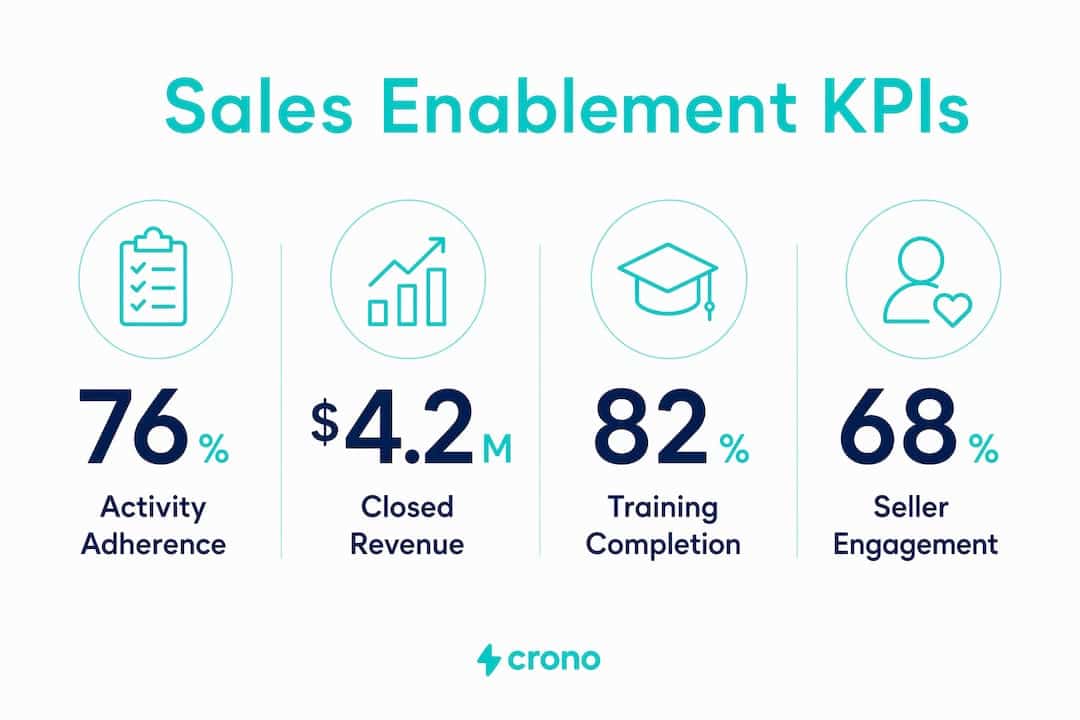
The measurement plan matters as much as the program itself. RevOps leaders need a short, defensible KPI dashboard that separates leading indicators (early signals of behavior change) from lagging indicators (revenue outcomes).
| KPI | Type | What It Measures |
|---|---|---|
| Activity adherence rate | Leading | Are reps following the prescribed sequence and cadence? |
| Role-play / assessment scores | Leading | Are skills improving before they show up in deals? |
| Ramp time to first quota | Lagging | How fast do new hires reach productivity? |
| Win rate by cohort | Lagging | Is enablement translating to closed revenue? |
| Average sales cycle length | Lagging | Is execution getting more efficient over time? |
| Rep retention at 12 months | Lagging | Does the program reduce costly turnover? |
Structure your pilot measurement plan around four elements: a defined cohort (one team or region), a 30-day baseline window before the platform goes live, clear success thresholds agreed with the executive sponsor, and a 90-day measurement window before drawing conclusions.
A simple ROI formula: (incremental closed revenue from pilot cohort) minus (platform cost + implementation time cost) divided by (platform cost + implementation time cost). RevOps should capture baseline win rate, average deal size, and ramp time before the pilot starts, or the formula has nothing to compare against.
How should you evaluate AI-driven sales execution platforms?
Use this checklist to score vendors on what actually matters operationally, not on feature marketing:
Integration and architecture features like native CRM integration, telephony and sequencing connections that work without custom development, and single sign-on and role-based access controls.
AI behavior and auditability including transparency on recommendations, update cadence, and data quality maintenance.
Pricing and scale factors such as per-user subscriptions with transparent AI credit usage, absence of hidden fees, and clear service level agreements.
Pro Tip: Ask vendors for a live demo using your own CRM data, not a sandbox. How a platform handles your actual data structure tells you more than any slide deck.
| Evaluation Dimension | Questions to Ask | Weight |
|---|---|---|
| CRM integration depth | Bidirectional sync? Field mapping flexibility? | High |
| AI explainability | Can you audit recommendations? | High |
| Security and compliance | Data residency, SOC 2, access controls? | High |
| Pricing transparency | Per-user cost, credit model, overage caps? | Medium |
| Support and onboarding | Dedicated CSM? Implementation SLA? | Medium |
What does a 90-day implementation roadmap look like?
A RevOps-led rollout moves through four sequenced phases. Keep the pilot cohort small (one team, 8–15 reps) and the timeline tight.
- Weeks 1–2: Assess gaps. Map current seller drag points, identify the CRM fields and workflows the platform needs to connect to, and confirm the baseline KPIs you will measure against.
- Weeks 3–4: Configure and integrate. Connect the platform to your CRM, load the initial content library, and set up the first AI-assisted sequences. Verify data flows before any rep touches the tool.
- Weeks 5–8: Pilot with one cohort. Run the pilot team through a structured onboarding. Managers get trained first, before frontline reps, so they can coach the new behaviors from day one.
- Weeks 9–12: Measure and iterate. Review leading indicators at week 8. Adjust sequences, content, and coaching focus based on what the data shows, then prepare the scale decision for leadership.
Training managers before frontline reps is the single most important sequencing decision. If managers lack coaching playbooks aligned to the new skills, rep training decays within weeks regardless of platform quality.
Pro Tip: Build a simple pilot scorecard with three columns: metric, baseline, and week-12 result. Share it with your executive sponsor at week 4 so there are no surprises at the final readout.
For teams deploying AI agents in sales workflows, aligning agent behavior to manager coaching cadences from the start prevents the common failure mode where AI recommendations and manager guidance contradict each other.
What pitfalls sink most enablement pilots?
Most pilots fail for predictable reasons, and each has a clear mitigation.
- Training reps before managers. Mitigation: prescriptive, manager-first training programs are the standard for a reason. Schedule manager enablement two weeks ahead of rep rollout.
- Tool sprawl without integration. Mitigation: require a live CRM integration demo before signing. A platform that sits outside your CRM will be ignored within 60 days.
- Opaque AI behavior. Mitigation: require explainability documentation and an audit log as contract terms, not as a post-sale request.
- Missing governance. Mitigation: assign a named content owner and a quarterly review cadence before launch, not after the content library goes stale.
- Measuring too late. Mitigation: capture baseline data before the pilot starts. Without a baseline, you cannot prove impact to the executive sponsor.
Pro Tip: If you hit week 6 and activity adherence is below 60%, pause and diagnose before proceeding. Low adoption at week 6 almost never self-corrects by week 12.
Key Takeaways
Modern sales enablement delivers measurable revenue impact when it centers seller experience, integrates directly with your CRM, and is reinforced by manager-led coaching from day one.
| Point | Details |
|---|---|
| Seller experience is the frame | Reducing seller drag, not just adding training, is what drives rep productivity and retention. |
| Manager-first sequencing | Train managers two weeks before reps so coaching reinforces, not contradicts, new platform behaviors. |
| Pilot with a defined cohort | Use 8–15 reps, a 30-day baseline, and a 90-day measurement window before scaling decisions. |
| KPIs span leading and lagging | Track activity adherence and assessment scores early; win rate and ramp time confirm impact later. |
| Crono as execution layer | Crono connects CRM, AI agents, enrichment, and multichannel outreach into one auditable workflow for B2B pilots. |
Where is the sales enablement category heading?
The category is moving faster than most RevOps roadmaps account for. The shift from “enablement as content library” to “enablement as execution layer” is already complete at the leading edge of the market. What is coming next is the standardization of seller experience metrics, the same way pipeline metrics became standard a decade ago.
Agentic AI is the bet worth making now. Not because it replaces human judgment, but because it handles the execution tasks (enrichment, sequencing, follow-up, signal monitoring) that currently consume a large portion of a rep’s day without producing buyer conversations. When those tasks are automated, the coaching conversation between manager and rep becomes the highest-leverage activity in the entire program.
Two trends to monitor over the next 18–36 months: explainable AI becoming a procurement requirement (not just a nice-to-have), and cross-functional orchestration tightening the loop between marketing campaign signals and rep outreach in near real time. Teams that build the governance model for that loop now will have a structural advantage when the tooling catches up.
The strategic bet I would make: invest in the CRM integration depth of your execution layer before you invest in more content. Content without execution context is just a library nobody visits.
Crono brings the execution layer to your enablement program
Pipeline that sits in your CRM without a connected execution layer is pipeline that leaks. Crono is built specifically to close that gap for B2B revenue teams: it connects your CRM to AI agents, contact enrichment, multichannel outreach (LinkedIn, email, and calls), and workflow automation in one unified platform, so your reps spend time on buyer conversations, not tab-switching.
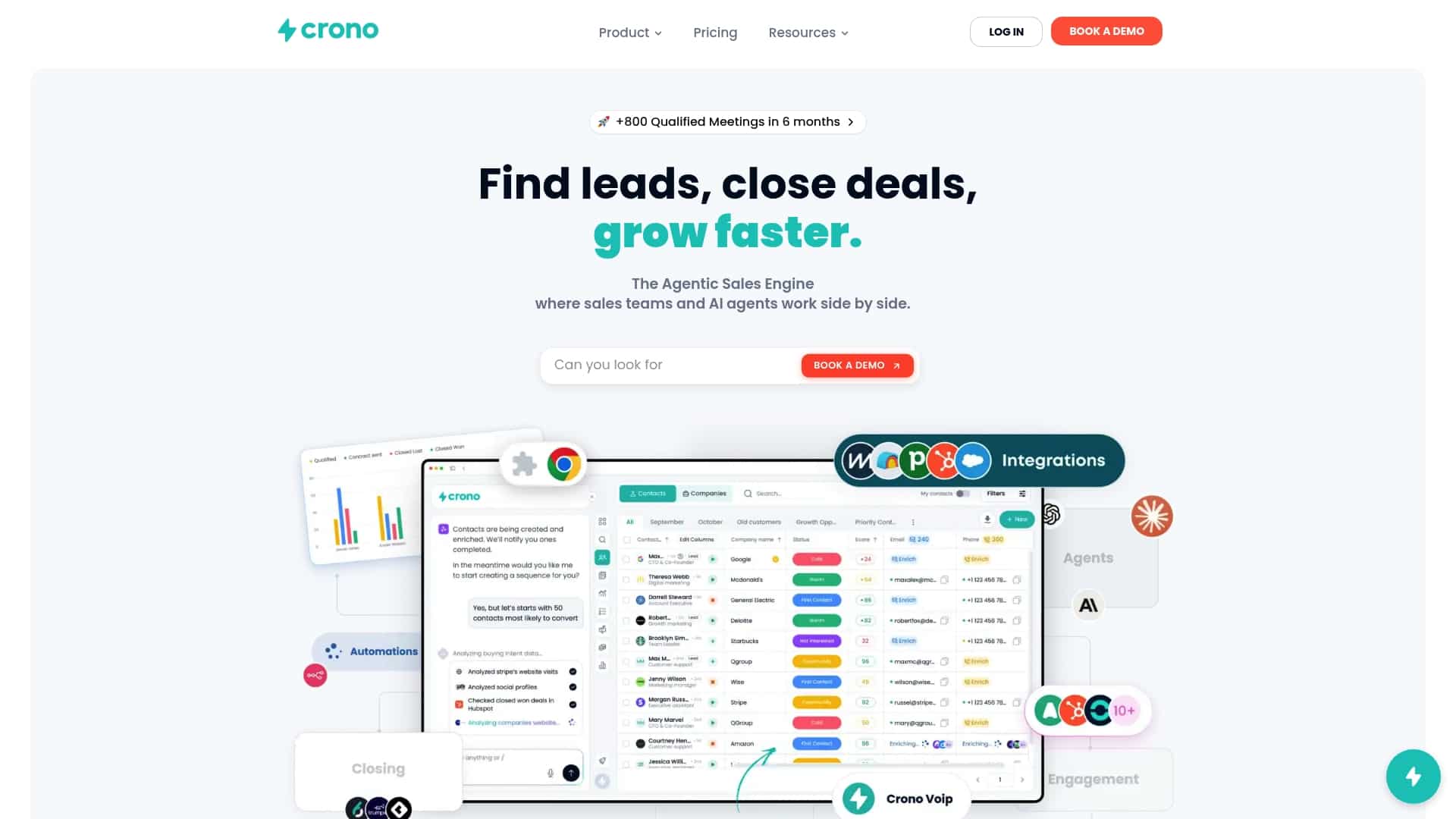
For a 90-day pilot, Crono maps directly to the checklist in this guide: bidirectional CRM sync, auditable AI recommendations, transparent per-user subscription pricing with clear AI credit usage, and a dedicated implementation path. Teams using Crono’s agentic sales execution model can configure sequences, enrich contact data, and launch multichannel outreach within the first two weeks of a pilot, which means you hit the measurement window with real activity data, not ramp-up noise.
Ready to run a structured pilot? Start with Crono’s platform and see how the execution layer performs against your baseline KPIs.
Useful sources and further reading
The claims in this guide draw on the following sources. Each is worth reading in full if you are building a business case or preparing a vendor evaluation.
- Gartner on sales enablement: The authoritative framing for seller experience and seller drag as the primary productivity levers. Use this to brief executive sponsors on why the category has evolved.
- HubSpot’s shared-discipline model: Practical guidance on Sales + Marketing co-ownership and the content feedback loop. Useful for governance design.
- The Brooks Group on sales training strategy: The case for prescriptive, role-targeted training and manager-led reinforcement over generic programs.
- Allego on continuous learning: The 90% forgetting-curve data and the argument for in-flow microlearning and AI coaching.
- Salesforce on enablement platforms: Best practices for CRM-integrated enablement and unified data.
- Crono’s AI sales agent deployment guide: Pilot examples, use cases, and implementation notes for AI-driven sales workflows.
- Crono’s AI sales coaching guide: KPIs, coaching playbooks, and technology guidance for leaders building the coaching layer of their program.
