
A good sales onboarding process moves a new rep from first day to independent selling through five phases: pre-boarding, orientation, training, supervised practice and ownership. Each phase has clear outcomes, real selling activity starts early, and a manager coaches against actual calls. Below you’ll find the phases, a week-by-week plan, the SDR variation, the coaching rhythm that follows, the metrics worth tracking and the mistakes that slow ramp time.
TL;DR
- Structure matters: onboarding programs rated highly for structure and consistent application outperform low-rated ones by 37%, cutting time-to-productivity from 9.1 to 5.7 months.
- Use five phases across about 90 days: pre-boarding, orientation, sales training, practice and application, independent selling.
- Front-load repetition and live conversations. Run all three tracks (knowledge, skill, pipeline) from week one and gate progress on competency, not the calendar.
- For SDRs, run a shorter 8 to 12 week ramp with measurable early goals and weekly reviews.
- Measure ramp time, early activity, quota attainment and first-year retention, and coach against real call recordings.
Table of Contents
- What a sales onboarding process is and why structure pays
- The five phases of a sales onboarding process
- How to onboard sales reps faster
- A 30-60-90 plan you can adapt
- How to adapt the process for SDRs
- What managers should do after onboarding ends
- How to measure whether onboarding works
- Common sales onboarding mistakes and how to avoid them
- Our perspective
- Put the process into your stack
- FAQ
- Sources
What a sales onboarding process is and why structure pays
Sales onboarding is the planned sequence of training, tool setup, coaching and milestones that takes a new seller from hire date to full productivity. It is more than a product orientation. It covers your buyers, your methodology, your systems and the habits you expect.
The evidence for structure is consistent. RAIN Group research reports that organizations with effective onboarding are 6.3x more likely to prepare new hires to succeed, yet only 35% of respondents rate their own onboarding as extremely or very effective. The same research ties effective onboarding to sellers being four times more likely to be productive in under three months, and to average turnover falling from 50% to 12% as effectiveness rises.
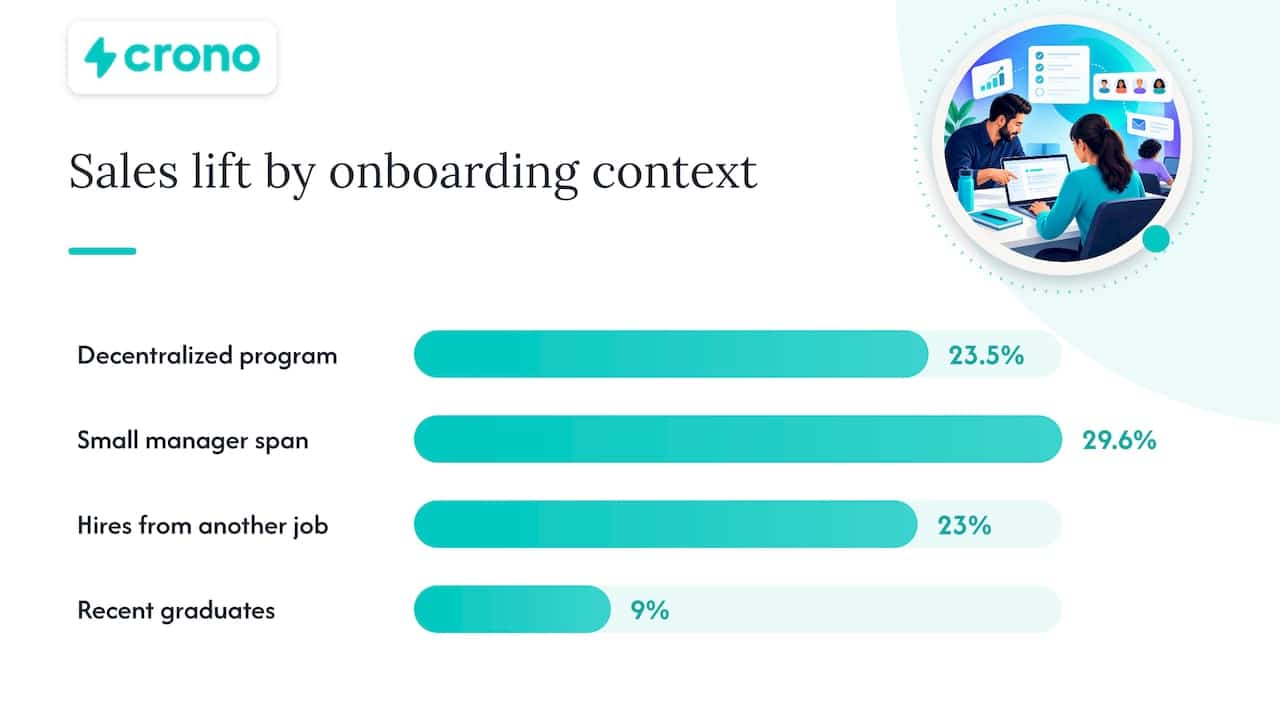
One academic finding is worth a manager’s attention. A 2022 Journal of Marketing study by Wiseman, Ahearne, Hall and Tirunillai, summarized by Baylor’s Keller Center, found that decentralized onboarding produced 23.5% higher sales than centralized programs. The gain rose to 29.6% when managers supervised fewer salespeople. The lift was about 23% for hires coming from another job and about 9% for recent graduates. The practical reading: a central curriculum is a foundation, but the manager closest to the rep shapes results, so keep manager spans small enough to coach.
The five phases of a sales onboarding process
Most strong programs follow the same arc. One published five-phase model from FirstHR is a useful template, and we’ve adapted it below with the activities that matter most in each phase.
| Phase | Timing | Core outcome | Key activities |
|---|---|---|---|
| 1. Pre-boarding | Before day one | Rep arrives ready to start | Offer letter, CRM and tool access, playbook, assigned buddy |
| 2. Orientation | Days 1-14 | Rep knows who you sell to and why | Mission, ICP, product foundations, CRM setup |
| 3. Sales training | Days 15-45 | Rep can run the methodology | Methodology, competitive landscape, call shadowing, pipeline building |
| 4. Practice and application | Days 46-60 | Rep sells with a safety net | Independent prospecting, role-play after shadowing |
| 5. Independent selling | Days 61-90+ | Rep owns a territory or book | Territory ownership, weekly pipeline reviews, 90-day formal review |
Forrester’s Sales Onboarding 90-Day Cadence takes a similar view: a 12-week template matching the first quarter, built on learning outcomes, learning pathways and ownership, and tailored to each sales role, managers included.
Phase 1: Pre-boarding
The gap between signing and starting is wasted time at most companies. Use it to remove friction: laptop, logins, CRM seat, sequences access and the playbook already in the rep’s inbox. Assign a buddy so the first message the rep gets is from a peer. If your playbook is scattered across documents, consolidate it first. Our guide to the sales playbook framework shows how to organize ICP, messaging and objection handling in one place.
Phase 2: Orientation
In the first two weeks, teach the business context: the mission, the ideal customer profile, how the product solves a specific problem and how your CRM is structured. Keep product depth proportionate. A rep who can describe the customer’s problem in the customer’s words is more useful than one who can recite every feature.
Phase 3: Sales training
This is where methodology, competitive positioning and live observation come in. Shadowing should be active: the rep takes notes against a simple scorecard and debriefs with the seller afterward. Begin building pipeline during this phase, not after it, so training connects to real accounts.
Phase 4: Practice and application
Reps prospect on their own and use role-play to rehearse what they saw while shadowing. OutBoundSalesPro suggests weekly role-play on scenarios such as discovery questions and objection handling, plus weekly product deep-dives throughout onboarding, to balance product education, skill development and cultural integration.
Phase 5: Independent selling
Hand over territory ownership, hold weekly pipeline reviews and finish with a formal 90-day review that compares results with the milestones you set on day one.
How to onboard sales reps faster
Speed comes from sequencing and repetition, not from cutting content.
- Front-load practice. SalesFocus reports that programs that concentrate repetition in the first two weeks cut ramp time by 30% to 40%, and that high-performing programs run 50 to 100 simulated calls in that window versus the 5 to 10 mock calls typical of most programs.
- Train for execution. A Forbes Business Council piece recommends training that reps can complete twice in two weeks, focused on actionable selling over exhaustive product knowledge, with around 100 focused repetitions for a confident pitch.
- Use AI role-play with guardrails. The same author suggests AI role-play platforms that simulate objections and give instant feedback. Start with three to five must-hit behaviors and a single ICP and sales stage for two weeks, and keep a human in the loop for nuance.
- Run tracks in parallel. PulseRevOps argues for running knowledge, skill and pipeline work from week one, gated by competency milestones rather than dates, so fast learners move on and strugglers aren’t pushed into full ownership too early.
The parallel model has a second benefit. By week two, the manager has real call recordings and discovery notes to coach against instead of hypotheticals. For a deeper look at tooling for that coaching, see our guide to AI tools for sales coaching.
A 30-60-90 plan you can adapt
Use this as a starting skeleton and replace the numbers with your own targets.
Days 1-30: Learn and observe
- Complete ICP, product and methodology modules.
- Master the CRM and core sales tools.
- Shadow at least several live calls and debrief each one.
- Complete the first block of simulated calls and pass the rubric.
Days 31-60: Practice with support
- Start outbound activity on a defined segment.
- Run live calls with the manager listening.
- Hit a defined discovery milestone, such as a target number of qualified conversations.
- Hold weekly role-play on the objections the rep actually hears.
Days 61-90: Own the pipeline
- Work a full territory or account list.
- Present a pipeline review to the manager each week.
- Complete a formal 90-day review with scorecard results.
- Agree on a development plan for the next quarter.
Our SDR ramp time playbook goes further into the 30-60-90 structure for outbound roles.
How to adapt the process for SDRs
SDR roles reward volume, resilience and a quick read of the prospect, so the ramp is shorter and more activity-heavy. SalesRoads recommends an 8 to 12 week ramp for entry-level SDRs:
- Weeks 1-2: product, market and buyer persona training.
- Weeks 3-4: CRM and tool mastery, plus call shadowing.
- Weeks 5-6: supervised outreach and role-play.
- Weeks 7-8 and beyond: independent outreach with ongoing coaching.
They also advise measurable early goals, with checklists, scorecards and weekly reviews that show gaps and guide coaching.
Vouris adds two points worth borrowing. Get SDRs used to rejection early by having them speak with real leads before the end of week one. And limit product training as a major focus, concentrating instead on sparking prospect interest and understanding the prospect’s problem.
If you want your SDRs to perform better sooner, the lever is less about more content and more about removing admin. Reps who spend their first month hunting for contact data, switching between tabs and building lists by hand ramp slowly. Connecting data, sequences and CRM into one workflow lets new SDRs spend their hours on conversations.
What managers should do after onboarding ends
The 90-day review is a checkpoint, not a finish line. Training Industry recommends a development roadmap with milestones, success metrics, coaching interventions and timelines, for example a 60-day needs-discovery goal. Its suggested rhythm:
- Weekly one-on-one coaching.
- Bi-weekly deal coaching.
- Monthly progress reviews.
- Daily or weekly accountability check-ins.
Keep learning going after onboarding as well: new competitors, new objections and new messaging all arrive after day 90. Coaching against real behavior is what makes this rhythm work. Calls, emails and CRM notes give the manager facts to discuss.
How to measure whether onboarding works
Track a small set of metrics at 30, 60 and 90 days and compare each cohort with the last.
| Metric | What it tells you |
|---|---|
| Time to first meeting, opportunity or deal | How quickly training turns into activity |
| Ramp time to quota | The headline measure of program speed |
| Quota attainment at 90 days and 6 months | Whether the ramp produced durable performance |
| Early retention | Whether reps stay long enough to repay the investment |
| Manager and rep feedback | Where the program confuses or drags |
For context, Networks Connect reports an average account executive ramp of about 5.7 months in the United States, up from about 5.3 months in 2022, and says 54% of top-performing reps report being fully onboarded and productive within three months versus 30% of low performers. Use such figures as a rough reference, then set your own baseline from your own cohorts.
Common sales onboarding mistakes and how to avoid them
- Information overload in week one. Reps retain little from a firehose of slides. Replace long product sessions with short modules followed by practice.
- Product knowledge over selling skill. Teach the buyer’s problem first, as described above for SDRs.
- Calendar-based progress. Moving everyone on the same date holds back fast learners and rushes slower ones. Use competency milestones.
- No early live conversations. Shadowing alone doesn’t build confidence. Put reps on real calls early, with a manager nearby.
- Coaching against hypotheticals. Record calls from week two and coach on what happened.
- Unclear goals. Without day-30, day-60 and day-90 targets, neither rep nor manager knows if the ramp is on track.
- Tools that aren’t ready. Missing access and unclean CRM data cost days. Fix this in pre-boarding.
- Managers stretched too thin. The Baylor-summarized research above points to the benefit of manager attention, so protect coaching time.
Our perspective
New reps rarely fail because they lack effort. They stall because the work around selling is fragmented: data in one tool, sequences in another, notes in the CRM, and priorities in someone’s head.
That’s why we built Crono as a sales execution layer. It connects your CRM and sales tools so people and AI agents work in the same workflows. Buying signals show a new rep which accounts deserve attention first, enrichment and list building remove the manual prep, and multichannel outreach across LinkedIn, email and calls sits in one place.
For onboarding, our approach is to shorten the distance between training and real pipeline. A rep who learns the playbook in week one and works signal-ranked accounts in week two gets the repetitions that drive ramp, and the manager gets visibility into what is happening, so coaching can start early.
Alex
Put the process into your stack
Once your phases and milestones are defined, the next question is how reps will execute them day to day. Crono connects your existing CRM and tools into one execution platform for prospecting, enrichment, outreach and pipeline tracking, so new hires work live accounts sooner.
Plans start at €79 per seat per month for Pro and €119 per seat per month for Ultra, and Enterprise is available on request. Teams that want AI agents running prospecting work can look at the Agentic Sales Engine, from €99 per month for 10,000 credits. See the current plans and pricing or explore the Agentic Sales Engine. For an example of results, read how Up2You raised sales team productivity by 15% with Crono.
FAQ
What are the stages of a sales onboarding process?
A common five-phase model runs from pre-boarding before day one, through orientation (days 1-14), sales training (days 15-45) and practice and application (days 46-60), to independent selling from day 61 onward. Each stage should end with a clear milestone before the rep advances.
How long should sales onboarding take?
Plan on roughly 90 days for account executives, in line with Forrester’s 12-week template. Entry-level SDRs are often ramped over 8 to 12 weeks. Gate progress on competency, since some reps will be ready earlier and some later.
How can I help new SDRs perform better faster?
Give them live conversations in week one, a short product curriculum focused on the buyer’s problem, weekly scorecard reviews and role-play on real objections. Remove manual work such as list building and data hunting so more of their day goes to outreach.
What should a sales onboarding checklist include?
Include tool and CRM access, the playbook, ICP and product training, methodology modules, a buddy, shadowing sessions, role-play, defined 30-60-90 goals and a formal 90-day review. Add the coaching cadence for the weeks after.
Sources
- Best Practices in Onboarding Salespeople, Baylor Keller Center
- Onboarding’s Impact on Sales Productivity, Sales Management Association
- How to Build a Sales Onboarding Process for New Hires, RAIN Group
- The Sales Onboarding 90-Day Cadence, Forrester
- Sales Onboarding: Complete Guide for Small Teams, FirstHR
- SDR Onboarding Checklist: A 30-60-90 Day Success Plan, OutBoundSalesPro
- How to Masterfully Onboard and Train a Sales Team, SalesFocus
- Sales Rep Onboarding, Forbes Business Council
- How do you cut sales rep ramp time in half, PulseRevOps
- 9 Common SDR Onboarding Mistakes and How to Avoid Them, SalesRoads
- The Onboarding Plan That Helped 100+ SDRs Hit Quota, Vouris
- 3 Ways to Accelerate Time to Productivity for New Sales Hires, Training Industry
- Cost to Hire Report, Networks Connect
