
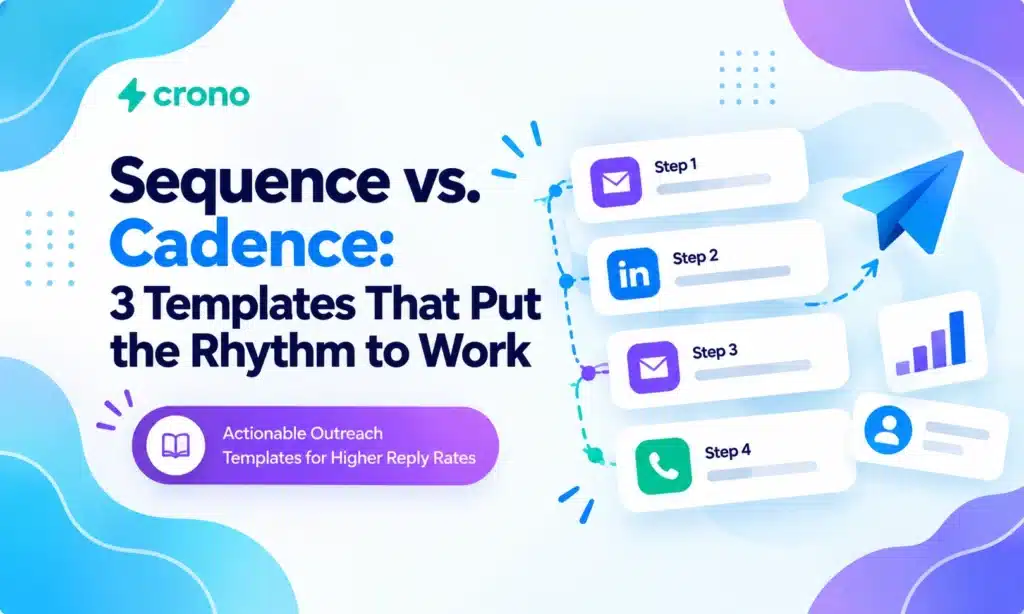
A sales cadence is the overarching rhythm and timing philosophy behind outreach: how many touches, how far apart, across which channels. A sales sequence is the specific, ordered set of messages and actions that execute that rhythm for a given segment or goal. Many sales teams use the terms interchangeably, but separating strategy from execution reduces friction and makes performance easier to measure.
TL;DR:
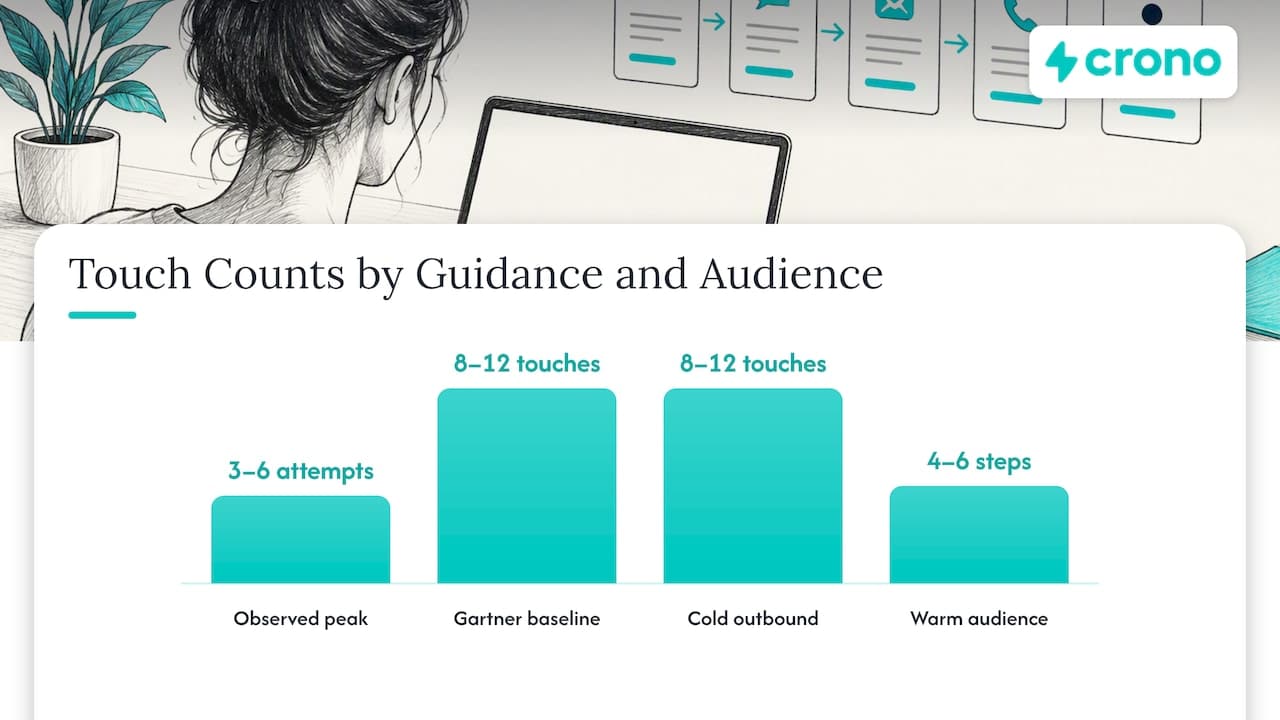
- Gartner recommends 8 to 12 meaningful touches over 2 to 4 weeks, while observed outbound performance often peaks at 3 to 6 attempts.
- Warm audience sequences work well with 4 to 6 steps, and they should move quickly toward a direct ask.
- Measure each sequence separately and inspect reply or conversion rates by step every two weeks, since combined results can hide where prospects drop off.
- Automate timing and touch limits, but have a person review AI suggestions before sending, especially in breakup emails and messages to dormant leads.
- Avoid scheduling two touches within 24 hours unless a prospect has shown clear intent, such as visiting a pricing page.
Table of Contents
- Definitions and how cadence maps to sequence
- How one cadence can host several sequences
- Touch counts, spacing, and personalization rules that work
- Three copyable sequence templates to start with
- How orchestration platforms turn cadence rules into running sequences
- Why sequences and cadences serve different strategic goals
- Using AI and automation inside cadences and sequences without losing control
- Adjusting cadence and sequence by buyer persona and deal stage
- Mistakes that undercut cadence and sequence performance
- Pick a vocabulary and test it this week
- How Crono keeps cadence rules consistent across every sequence
- FAQ
- Sources
Definitions and how cadence maps to sequence
A sales cadence is the policy layer: it sets the duration of a campaign, the number of touch attempts, the spacing between them, and the channels allowed. A sales sequence is the execution layer: the actual templates, call scripts, and LinkedIn messages, arranged in a specific order for a specific audience. Forrester’s research on sales engagement cadences describes cadence in terms of five elements: duration, touch attempts, time between attempts, delivery mechanisms, and delivery content. A sequence inherits those rules and fills them in with real content.
HubSpot’s sequence research frames the distinction the same way: cadence is the strategic schedule, sequence is the tactical script. Think of cadence as the tempo marking on a piece of sheet music and sequence as the notes a musician actually plays within that tempo. The rhythm stays constant; the notes change based on who is listening.
This mapping holds across most sales organizations:
- Cadence defines: campaign duration, number of attempts, spacing rules, approved channels.
- Sequence defines: message copy, call scripts, step order, personalization tokens.
- Cadence answers: “how aggressive should our outreach be?”
- Sequence answers: “what do we actually say, and in what order?”
The two terms get muddled for a reason: most sales engagement platforms bundle both into a single “sequence” builder, where reps set timing and write copy in the same interface. That convenience blurs the conceptual line, but it doesn’t erase it. When a sales leader says “tighten the cadence,” they mean adjust the pacing policy. When a rep says “update the sequence,” they mean change what gets sent. Common misuses include calling a single email template a “cadence” or calling a company-wide timing policy a “sequence.” Standardizing this vocabulary internally, even informally, speeds up onboarding and makes it easier to diagnose whether a problem is strategic (wrong rhythm) or tactical (wrong message).
How one cadence can host several sequences
A single cadence policy, say, 10 touches over 18 business days, can govern multiple sequences built for different goals. The cadence sets the outer boundaries: how many attempts, how much time between them, which channels are fair game. Each sequence then adapts those boundaries to its specific audience and intent.
- Cold outbound to a target account list. The cadence allows up to 10 touches over three weeks across email, phone, and LinkedIn. The sequence front-loads two emails and a call in the first five days, then tapers off with a LinkedIn connection request and a breakup email in week three.
- Post-webinar follow-up. The same cadence rules permit fewer touches since the lead is warmer. The sequence compresses to five steps over seven days: a same-day thank-you email, a personalized follow-up referencing the session topic, a call attempt, and two light-touch nudges.
- Re-engagement of a dormant lead. The cadence here stretches the spacing considerably, maybe 60 days between the first and last touch, because the goal is to avoid feeling pushy. The sequence opens with a value-add email (a case study or a product update), waits two weeks, then tries a different channel entirely.
In each case, the cadence rules (spacing, maximum touches, approved channels) shape how aggressive or patient the sequence can be, while the sequence itself determines what gets said and when within those limits.
Metrics should be tracked per sequence, not just per cadence, since mixing results across very different audiences hides what’s actually working. For the cold outbound sequence, watch reply rate and meetings booked per hundred contacts. For the webinar follow-up, track conversion from attendee to meeting within 14 days. For re-engagement, measure reactivation rate: how many dormant leads re-enter an active pipeline stage. Reviewing these metrics at the step level, not just the sequence level, shows exactly where prospects drop off and which touch is pulling its weight.
Touch counts, spacing, and personalization rules that work
Industry guidance offers a reasonably consistent baseline, though real-world execution varies. Gartner’s research on sales development strategies recommends roughly 8 to 12 meaningful touches over a 2 to 4 week campaign as a best-practice baseline, though observed outbound performance often clusters around 3 to 6 attempts for peak effectiveness in many scenarios. That gap matters: teams that stop at four touches because “that’s usually enough” may be leaving meetings on the table, while teams chasing 15 touches may be wearing out a list without a clear return.
Statistic callout: Industry guidance from Gartner points to 8 to 12 touches over 2 to 4 weeks as a best-practice baseline for sales development cadences. That range gives reps enough attempts to reach a busy buyer without crossing into fatigue territory.
HubSpot’s sequence playbook adds useful nuance by audience temperature: cold outbound sequences tend to run longer, around 8 to 12 touches, while sequences aimed at warmer audiences like event attendees or trial users work well with 4 to 6 steps. The colder the lead, the more patience and persistence the sequence needs; the warmer the lead, the faster it should move to a direct ask.
A few operating rules make this guidance practical:
- Front-load your highest-effort touches. Put the most personalized email and the first call attempt in the opening days, when interest and recall are highest.
- Space out, don’t crowd. Avoid stacking two touches in 24 hours unless the lead has shown explicit intent, like opening a pricing page.
- Mix channels deliberately. Email carries the bulk of volume, but a well-timed call or LinkedIn message often breaks through when email goes quiet.
- Automate structure, personalize substance. Let the cadence (timing, step order) run on automation; keep the first line of each message, and any reference to the prospect’s specific situation, written by a human or reviewed before it sends.
Pro Tip: Review step-level reply and conversion rates every two weeks rather than waiting for a full sequence to finish, so you can kill or adjust underperforming steps before they drag down the whole campaign.
Forrester’s guidance on cadence elements also points to a less obvious lever: coachability. Teams that run fewer, well-measured sequences with disciplined testing tend to outperform teams juggling dozens of untracked variations. That means picking two or three core sequences, instrumenting them thoroughly, and iterating based on real step-level data rather than launching a new sequence every time a rep has an idea.
Three copyable sequence templates to start with
These templates give you a starting structure. Adjust timing and tone based on your industry, average deal size, and how your buyers typically respond.
- Cold outbound, 10 steps over about three weeks. Day 1: personalized email referencing a specific trigger (funding round, new hire, product launch). Day 2: LinkedIn connection request with a short note. Day 4: first call attempt. Day 6: follow-up email with a relevant case study. Day 9: second call attempt. Day 11: LinkedIn message with a useful resource, no ask. Day 14: breakup-style email reframing the value proposition. Day 16: third call attempt. Day 18: short, direct email asking for a referral if the prospect isn’t the right contact. Day 21: final email closing the loop, inviting them to reach out later.
- Event or webinar follow-up, 5 to 7 steps over about ten days. Day 0 (same day): thank-you email with a session recap or recording link. Day 2: personalized email tying their stated interest to a specific use case. Day 4: call attempt referencing something they said or asked during the event. Day 6: LinkedIn connection with a one-line note. Day 8: light-touch email offering a relevant resource. Optional Day 10: final nudge proposing a short call.
- Re-engagement for dormant leads, 4 to 5 steps spread over 45 to 60 days. Day 1: value-add email, a product update or industry insight, no direct ask. Day 15: second email referencing a new relevant development, like a feature release tied to their original interest. Day 30: call attempt, low-pressure, checking on current priorities. Day 45: LinkedIn message with a specific, timely reason to reconnect. Day 60: closing email, gated on no prior response, offering to close the file or hear back on timing.
When adapting these for your own team, keep the cadence rules (spacing and total touches) fixed first, then adjust the sequence content for industry language, role-specific pain points, and deal size. A sequence built for enterprise IT buyers should sound different from one built for small business owners, even if both run on the same 10-step cadence. For teams managing cross-channel timing across email, calls, and social, a cadence timing playbook can help translate these touch-count ranges into a day-by-day schedule.
How orchestration platforms turn cadence rules into running sequences
Once a team has agreed on cadence policy and built out sequence templates, the harder problem is execution at scale: keeping dozens of reps consistent, enforcing spacing rules automatically, and surfacing which steps are working. This is where a sales execution layer earns its keep. Orchestration software takes the cadence rules (max touches, spacing, allowed channels) and applies them automatically across every sequence running in the system, rather than leaving timing discipline to individual reps’ memory.
Look for these capabilities when evaluating a platform for this job:
- CRM synchronization, so sequence activity and outcomes write back to the same record reps already work from.
- Multichannel execution, covering email, calls, and LinkedIn from one workflow rather than three disconnected tools.
- Automation rules that enforce spacing and touch limits without requiring a rep to track dates manually.
- Signal-driven prioritization, surfacing which accounts or contacts are showing buying intent so reps spend time where it counts.
- Step-level analytics, reporting reply and conversion rates per touch, not just per sequence.
We built Crono around this exact problem: connecting a team’s CRM and outreach channels into one execution layer so cadence policy and sequence content work together instead of living in separate spreadsheets and tool tabs. Rather than asking reps to remember spacing rules, the platform applies them automatically while surfacing buying signals that help prioritize which sequence a given contact should enter. Readers who want a deeper look at how orchestration changes outbound execution can review our sales engagement overview.
Why sequences and cadences serve different strategic goals
A cadence exists to protect consistency and avoid two failure modes: under-reaching a prospect who might convert, or over-reaching one who’s already said no. Its strategic job is pacing and discipline across the entire funnel, regardless of which specific campaign is running. A sequence exists to convert a particular audience in a particular context, which is a narrower, more tactical objective.
This distinction shows up clearly in how each gets changed over time. A cadence rarely needs adjustment unless broader patterns shift, like reply rates dropping across every sequence running under it, suggesting the overall pacing is off. A sequence gets revised constantly: new subject lines, a different opening line, a reordered step, based on what a specific segment responds to. Treating the two as separate also clarifies ownership. Sales leadership typically sets cadence policy since it affects brand reputation and prospect experience broadly. Individual reps or RevOps often own sequence content since it needs to flex quickly based on what’s converting. Keeping that split explicit prevents a common failure: a rep quietly stretching the cadence to “just one more touch” because a sequence feels like it’s working, which erodes the pacing discipline the cadence was built to protect.
Using AI and automation inside cadences and sequences without losing control
AI tools fit most naturally into the sequence layer, where they can draft personalized opening lines, suggest subject lines based on past performance, or flag which prospects are likely to respond to a given channel. Automation fits more naturally into the cadence layer, enforcing spacing rules and triggering the next step on schedule without a rep needing to track dates manually. Keeping that split in mind prevents a common mistake: letting an AI tool silently override cadence timing because it predicts a prospect is “ready,” which can undercut the pacing discipline a team has deliberately set.
Some research into derived cadence modeling describes methods for analyzing interaction data, like call timestamps and email opens, to recommend optimized timing and channel switches. These approaches can be useful signals, but they work best layered on top of an explicit cadence policy rather than replacing one, since a model trained purely on past behavior can drift away from a team’s actual sales methodology. A practical approach: let automation handle step triggering and basic personalization at scale, use AI suggestions as a draft a rep reviews rather than a message that sends untouched, and keep a human checkpoint on any step where tone or specific context matters most, like a breakup email or a re-engagement opener.
Adjusting cadence and sequence by buyer persona and deal stage
A single cadence policy rarely fits every persona or stage well. An enterprise buyer researching a six-figure purchase tolerates, and often expects, a longer, more patient cadence with more total touches spread over more weeks, since their internal buying process takes time. A small business owner evaluating a lower-cost tool usually responds better to a tighter, faster cadence since their buying cycle is shorter and their patience for a long drip campaign is lower.
Deal stage matters just as much as persona. A cold prospect who has never heard from your team needs a sequence built around earning initial attention: a relevant trigger, a clear value statement, minimal asks. A prospect who has already taken a meeting needs a completely different sequence, one built around moving a specific next step forward, like scheduling a technical review or looping in a decision maker. Applying the same generic sequence to both situations wastes the cadence’s structure. In practice, this means maintaining a small library of sequences mapped to persona and stage combinations, rather than one all-purpose sequence stretched to cover every scenario. The cadence rules can often stay similar across personas; the sequence content is where the real adaptation happens.
Mistakes that undercut cadence and sequence performance
The most common mistake is treating cadence and sequence as the same decision, so that changing one message changes the whole timing philosophy, or vice versa. This makes it hard to diagnose problems: a dip in replies might be a pacing issue (cadence) or a messaging issue (sequence), and conflating them means guessing at the fix.
A second frequent error is running too many sequences at once without the instrumentation to tell which ones work. Forrester’s research on cadence elements points to coachability and disciplined testing as bigger performance levers than sheer sequence volume. A handful of well-measured sequences beats a dozen untracked ones.
Other pitfalls worth watching for:
- Ignoring step-level data and only reviewing overall sequence conversion, which hides exactly where prospects drop off.
- Over-automating personalization, sending templated messages that read as generic despite a merge field with the prospect’s name.
- Letting cadences run indefinitely without a defined end point, which wears out lists and creates poor sender reputation.
- Skipping the breakup step, a surprisingly effective close in many cold sequences that gives the prospect a reason to respond before the sequence ends.
Pick a vocabulary and test it this week
Clear cadence and sequence vocabulary saves real time once a team adopts it. New reps ramp faster when “fix the cadence” and “fix the sequence” point to two distinct, well-understood fixes instead of one vague catch-all complaint about outreach not working. The conventional wisdom treats this as a semantic nitpick; in practice, it’s an operational shortcut that speeds up every diagnosis after a sequence underperforms.
My suggestion: document your current cadence policy in one paragraph, pick one sequence template from this article, and run it for two weeks before touching anything else.
— Alex
How Crono keeps cadence rules consistent across every sequence
Running the templates and rules above by hand across a growing team gets difficult fast, which is the exact problem we built Crono to solve. We connect your CRM and outreach channels (email, calls, LinkedIn) into one execution layer, so cadence spacing and touch limits apply automatically across every sequence your team runs, instead of depending on individual reps to track timing manually.
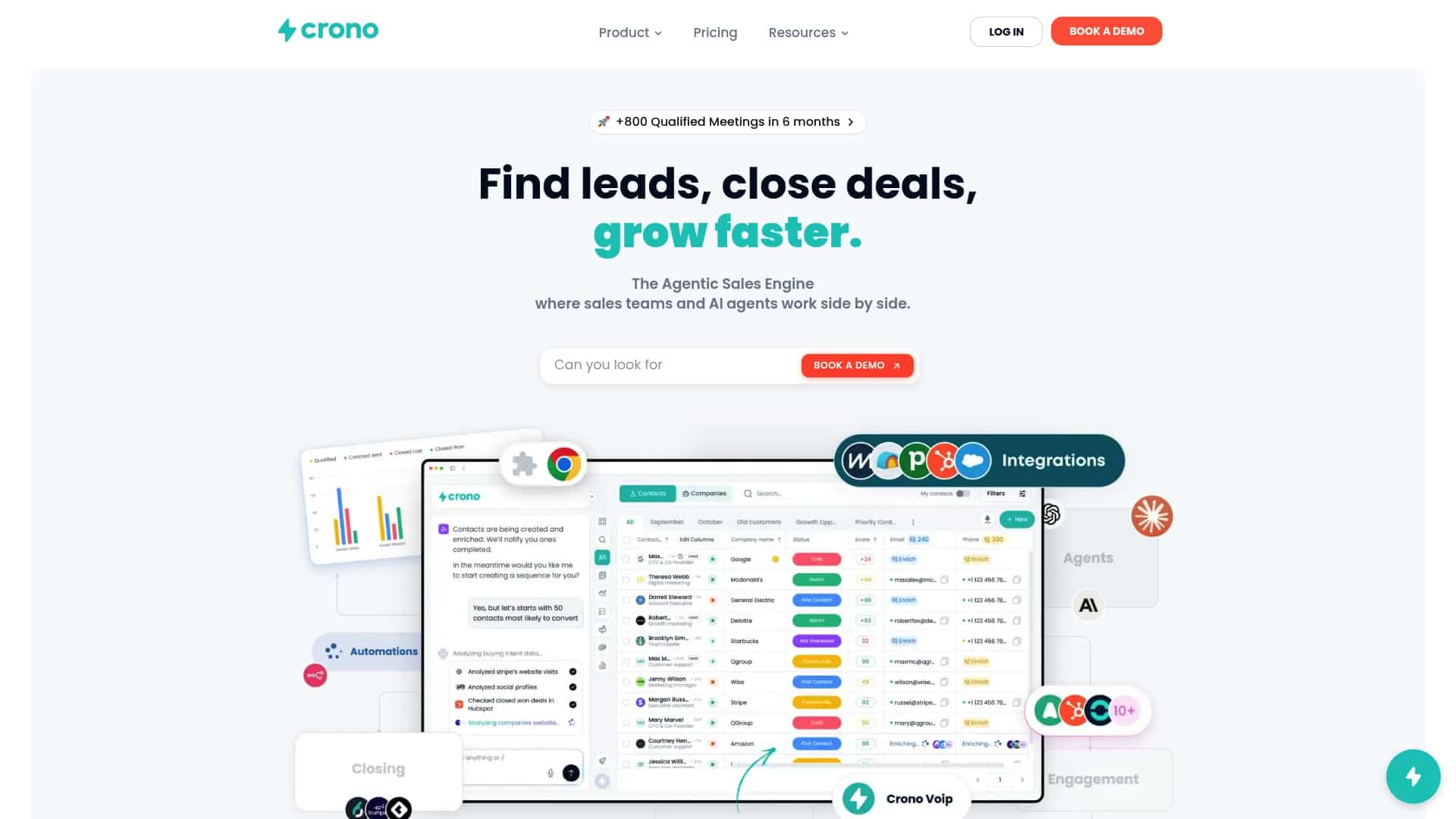
Our platform also surfaces buying signals to help prioritize which contacts enter which sequence, and our Agentic Sales Engine extends that automation with AI agents that handle repetitive execution steps. Plans start with Pro at €79 per month per seat, with Ultra and Enterprise tiers available for teams running more sequences at scale. Explore current plans on our pricing page or request a demo to see how cadence enforcement works inside your own CRM.
FAQ
What is the definition of a sales cadence?
A sales cadence is the overall timing and rhythm policy for outreach: how many touches, how far apart, and which channels are allowed across a given campaign window. Gartner’s guidance frames this as roughly 8 to 12 meaningful touches over 2 to 4 weeks as a best-practice baseline. The cadence sets the pacing rules; the sequence fills in the actual content.
Is tempo the same as cadence?
Tempo and cadence describe closely related ideas, both referring to the pace or rhythm of repeated action, but in sales, “cadence” is the standard term for the specific policy governing touch frequency and spacing. “Tempo” is sometimes used informally to describe how fast or slow that cadence feels to a prospect. They aren’t interchangeable as formal sales terms, since cadence implies a documented set of rules while tempo describes a general impression of pace.
Is it spelled cadence or cadance?
The correct spelling is “cadence,” with an “e” before the final syllable. “Cadance” is a common misspelling and does not appear in standard dictionaries or sales terminology.
What is sequence in sales?
A sales sequence is the specific, ordered set of touchpoints, emails, calls, LinkedIn messages, and the scripts or templates used at each step, built to execute a cadence’s timing rules for a particular audience. HubSpot’s sequence research describes cadence as the strategic schedule and sequence as the tactical execution of that schedule. A single cadence can support multiple sequences built for different segments or goals, such as cold outbound versus event follow-up.
Sources
- Sales sequences: 12 best practices for B2B teams in 2026 — HubSpot
- 11 Sales Development Strategies for High-Growth Companies — Gartner
- Elements of a sales engagement cadence — Forrester
