⚡️Bolt - The B2B Sales newsletter by Crono
Subscribe to our newsletter to receive monthly updates and insights on the future of B2B Sales!
A sales playbook framework is defined as a centralized operating manual that codifies your team’s repeatable sales process, documenting ideal customer profiles, qualification frameworks like MEDDIC or BANT, messaging, and objection handling in one place. It is the operational blueprint your reps use to execute consistently and close more deals. Without it, every rep invents their own approach, and performance becomes unpredictable. Sales leaders who build and enforce a playbook framework gain a direct lever on win rates, ramp time, and forecast accuracy. Understanding what this framework contains and how to build it is the first step toward scaling a high-performing sales team.
A sales playbook framework is a centralized operating manual that codifies a team’s repeatable sales process. It captures everything a rep needs to execute at each stage of a deal, from the first outreach to contract signature. The framework is not a slide deck or a training document. It is a living reference that reps and managers use daily.
One distinction matters here. A sales process defines your deal stages. A sales playbook framework defines how reps execute within each stage to advance deals effectively. Both are necessary. The process tells you where a deal is. The playbook tells you what to do next.
Sales leaders often confuse the two, which leads to pipeline stages that look clean on paper but hide deals that are stuck or misqualified. The playbook closes that gap by giving reps specific actions, questions, and criteria at every step.

An effective playbook framework covers seven core areas. Each one addresses a specific failure point in the sales process.
Pro Tip: Keep your playbook to 10–20 pages. Playbooks that run longer than 20 pages see sharply lower adoption rates among reps during onboarding and live deals.
| Component | Primary purpose |
|---|---|
| Ideal Customer Profile | Focuses rep effort on accounts most likely to close |
| Qualification framework (MEDDIC/BANT) | Removes guesswork from deal quality assessment |
| Messaging and talk tracks | Standardizes discovery and value demonstration |
| Objection handling | Prepares reps for the most common deal blockers |
| Mutual action plan | Aligns buyer and seller on next steps and timelines |
The most measurable benefit of a playbook framework is speed to productivity. A well-executed playbook reduces AE ramp time by 66%, enabling new hires to reach full productivity in 30 days versus the industry average of 90 days. That difference translates directly into revenue. A rep who closes their first deal in month one instead of month three generates three additional months of quota contribution in their first year.
Win rates improve for a related reason. When reps follow a qualification framework consistently, they spend less time on deals that will never close. Qualification frameworks like MEDDIC improve win rates by 20–30% compared to traditional unstructured approaches. That improvement comes not from closing harder but from qualifying better earlier.
“The biggest challenge in playbooks is sustained enforcement through manager coaching and pipeline management to keep content relevant and actionable.”
Forecasting reliability also improves when the playbook is enforced. When every deal in the pipeline has been qualified against the same criteria, pipeline reviews become faster and more accurate. Sales leaders can identify at-risk deals earlier and coach reps before a deal is lost. For teams using AI-powered sales coaching, playbook criteria can be embedded directly into coaching workflows, making enforcement automatic rather than dependent on manager memory.
The most common mistake sales leaders make is treating the playbook as a one-time project. A playbook built in january and never updated becomes irrelevant by march. Markets shift, competitors change their positioning, and your team learns new patterns from closed deals. A static playbook fails to capture any of that.
Playbooks that lack manager enforcement in deal-level coaching typically become obsolete within 60 to 90 days. The playbook decays not because the content is wrong but because no one is checking whether reps are using it. Manager pipeline reviews are the enforcement mechanism. Without them, the playbook becomes a document that lives in a shared folder and gets ignored.
Here are the best practices that prevent playbook decay:
Pro Tip: Assign one owner to the playbook, typically the head of sales or a senior sales enablement manager. Shared ownership without a single accountable person leads to the playbook going stale.
Companies that rigorously enforce qualification frameworks report significantly improved pipeline accuracy and deal quality. Enforcement is not optional. It is the mechanism that makes the playbook work.
Building a playbook before you have enough deal data produces a theoretical document that does not reflect how your best deals actually close. Wait until you have closed 10–20 deals before building your first playbook. Those deals contain the patterns your playbook needs to capture.
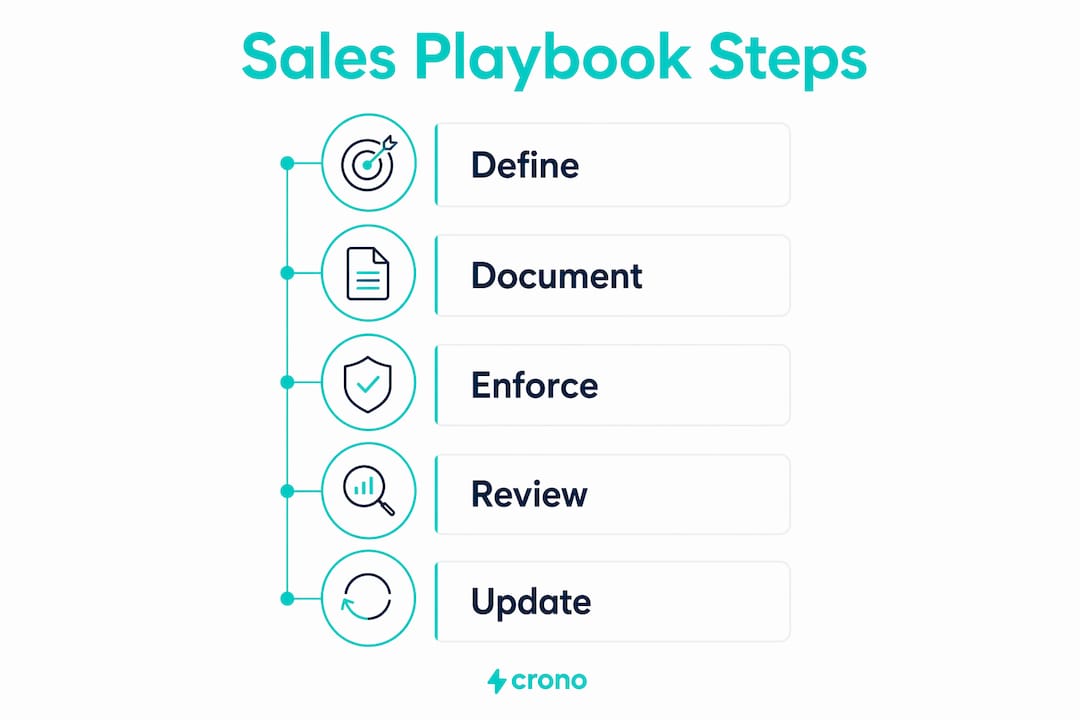
Follow these steps to build and implement a playbook that your team will actually use:
For teams building AI-assisted sales playbooks, the process above can be accelerated significantly. AI tools can analyze call recordings, identify winning patterns, and surface the objections and questions that appear most often in successful deals.
A sales playbook framework is the single most effective tool for making sales team performance repeatable, measurable, and scalable across every rep and every deal.
| Point | Details |
|---|---|
| Playbook vs. process | The sales process defines deal stages; the playbook defines how reps execute within each stage. |
| Ramp time impact | A well-enforced playbook reduces AE ramp time from 90 days to 30 days. |
| Win rate improvement | Qualification frameworks like MEDDIC improve win rates by 20–30% over unstructured approaches. |
| Enforcement is critical | Playbooks without manager enforcement in pipeline reviews decay within 60 to 90 days. |
| Build from real data | Wait for 10–20 closed deals before building your playbook to capture actual winning patterns. |
Most sales leaders I have worked with treat the playbook as a project. They build it, share it, and move on. That is the wrong mental model. A playbook is infrastructure, the same way your CRM or your compensation plan is infrastructure. It requires maintenance, ownership, and active use to deliver value.
The managers who get the most out of their playbooks are the ones who reference it in every pipeline review and every coaching session. They do not ask reps to memorize it. They create the conditions where using the playbook is the path of least resistance. When a rep knows that every deal review will include a MEDDIC check, they start qualifying more carefully before the meeting. That behavioral shift is where the real performance gains come from.
The other insight I would share is that the best playbooks are built bottom-up, not top-down. The most useful content comes from your top performers, not from sales methodology books or consulting frameworks. Interview your best reps. Record their calls. Ask them what questions they ask in discovery and how they handle the objections that kill deals. That content, written down and shared with the rest of the team, is worth more than any generic framework.
A playbook that reflects how your best people actually sell will always outperform one that reflects how someone thinks selling should work in theory. Build it from the ground up, enforce it through your managers, and update it every quarter. That is the formula.
— Alex
A playbook is only as good as the execution layer behind it. Crono is built to be that execution layer for modern B2B revenue teams.
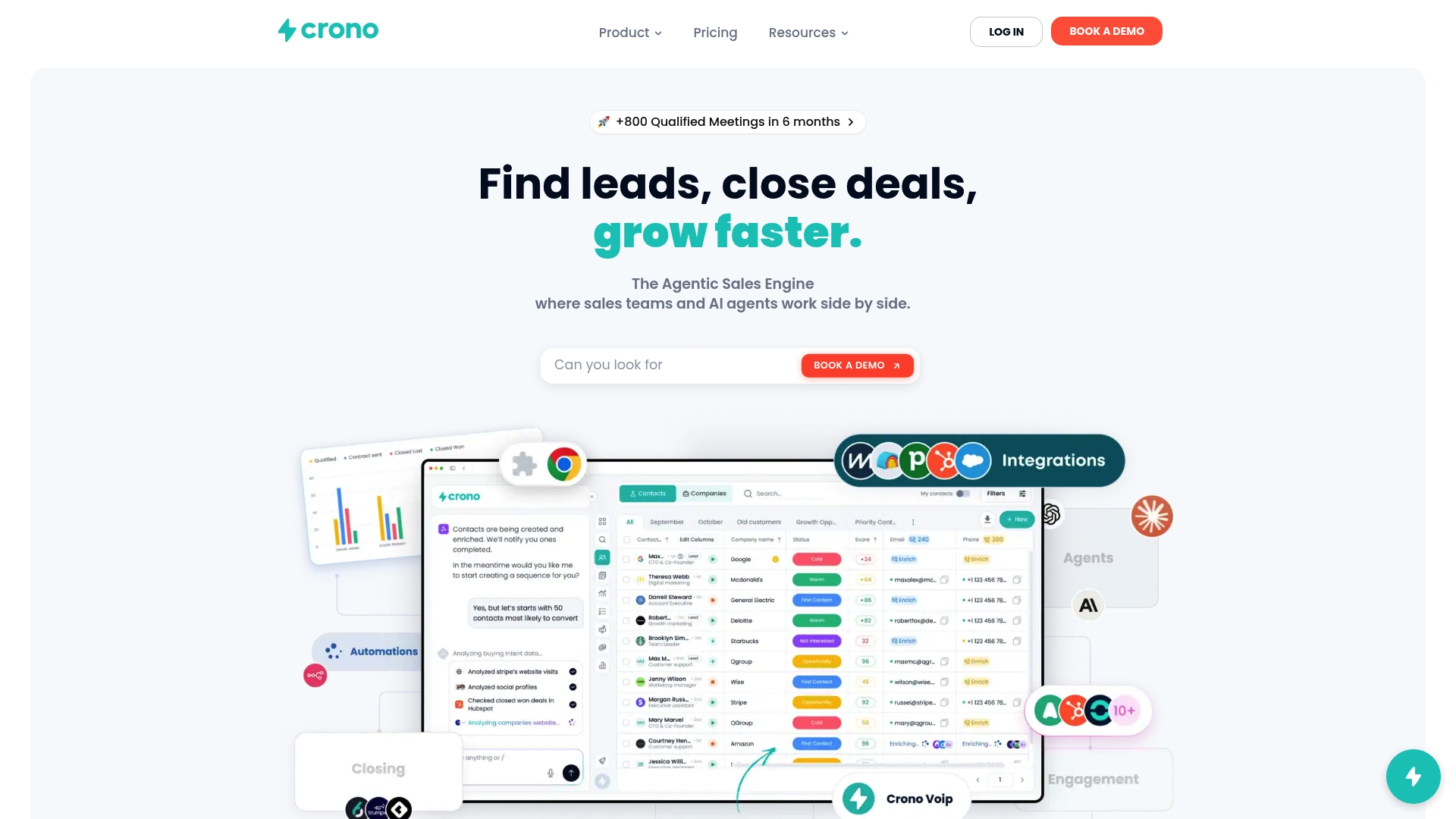
Crono combines AI agents, workflow automation, and multichannel engagement in a single platform. Sales leaders use Crono to embed playbook criteria directly into pipeline reviews, automate outreach cadences, and coach reps against real deal data. If you want to see how AI agents can accelerate playbook adoption and reduce ramp time, the guide to deploying AI sales agents in B2B sales is a practical starting point. For teams focused on coaching, Crono’s sales orchestration capabilities align every rep’s activity with the qualification criteria your playbook defines.
A sales playbook framework is a centralized operating manual that documents your team’s repeatable sales process, including ICPs, qualification frameworks, messaging, and objection handling. It defines how reps execute at each stage of a deal, not just what the stages are.
A sales process defines the stages a deal moves through. A sales playbook framework defines the specific actions, questions, and criteria reps use to advance deals within each stage. Both are required for consistent sales outcomes.
Effective sales playbooks stay within 10–20 pages. Longer playbooks see lower adoption rates during onboarding and in live deal situations.
Build your first playbook after closing 10–20 deals. That deal history gives you the real patterns, objections, and qualification signals your playbook needs to be accurate and useful.
Run weekly pipeline reviews that assess deals against playbook criteria, and schedule a full playbook update every quarter. Without manager enforcement in deal reviews, playbooks typically decay within 60 to 90 days.