
A call and email cadence is a planned sequence of emails, calls and voicemails sent to one prospect over a fixed window. For most B2B outbound, a good starting point is 8 to 12 touches over about three weeks. Lead with a personalized email, follow within a day or two with a call and voicemail that references it, then alternate channels with wider gaps as the sequence goes on. This guide gives you the order, the spacing, a day-by-day template, what to say at each touch, and the numbers to track.
TL;DR
- Aim for 8 to 12 touches over 17 to 21 days, split roughly between email and phone, with LinkedIn as a supporting channel.
- Start with email, call within one to two days, then alternate. Space touches 1 to 3 days apart early and 5 to 7 days apart later.
- Every touch must add something new: a different angle, proof point or question. Repeating the first email shorter is the most common failure.
- Track reply rate, meeting rate, touches to meeting and completion rate, then change one variable at a time.
- Use buying signals to break out of the sequence and call the moment a prospect shows interest.
Table of Contents
- Why combine calls and emails in one cadence
- How many touches and how long
- Order and spacing: what goes first
- A 12-touch call and email cadence template
- What to say at each touch
- Use signals to break out of the cadence
- Measure and adjust
- Run your cadence in one place
- FAQ
- Sources
Why combine calls and emails in one cadence
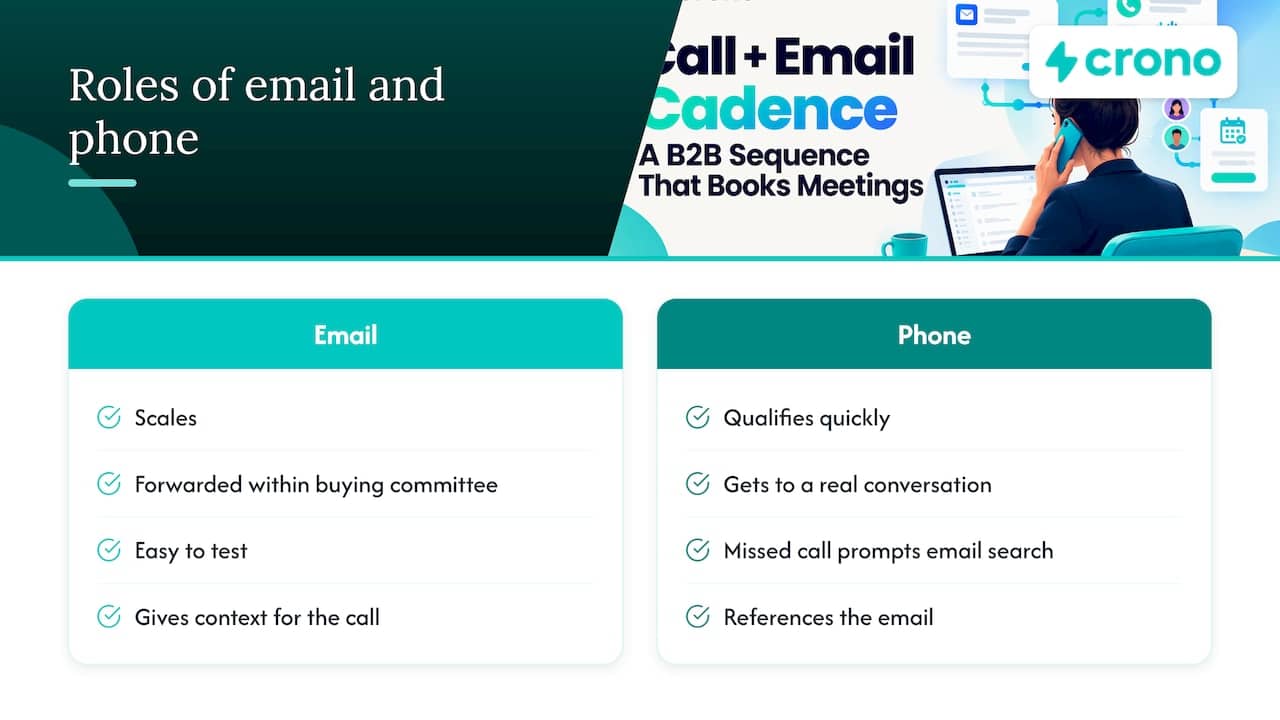
Email and phone do different jobs. Email scales, can be forwarded inside a buying committee and is easy to test. The phone qualifies quickly and gets to a real conversation. Pete Kazanjy’s Founding Sales handbook describes a cadence as the interleaving of outreach actions over time, typically alternating emails, calls and voicemails, and suggests using opens and clicks to decide who gets a call first.
The channels also reinforce each other. A voicemail or missed call gives the prospect a reason to look for your email, and the email gives them context for the call. Treat the two as one conversation held in two places rather than two separate campaigns.
Do cold calls and emails still work?
Yes, but the bar has risen. Benchmarks vary by team, data quality and audience, so use them as ranges, not promises:
| Benchmark | Figure | Source |
|---|---|---|
| Call connection rate | 42.1% | Konsyg 2026 outbound benchmarks, 56,604 calls |
| Email response rate | 7.0% | Same report, 87,015 emails |
| Raw cold email reply rate | 2.66%, with 0.70% positive | Analysis of 1.29 million cold emails |
| Average email reply rate | 6.8% (2023) to 5.8% (2024) | Belkins 2025 benchmarks |
The spread between 2.66% and 7.0% is the point. Reply rates depend on who you target, how clean the contact data is and how relevant the message is. Falling averages show that a single email no longer carries a prospecting program, which is exactly the case for a multi-touch cadence.
How many touches and how long
Most published guidance clusters in the same place. One 2026 guide recommends 8 to 12 touchpoints across 17 to 21 days spread over email, phone and LinkedIn, and notes that many deals need 5 to 12 touchpoints. That is a good default for mid-market outbound.
Adjust by context:
- Cold, high-volume segments: 8 touches over about two weeks. Keep it tight and move on.
- Mid-market and strategic accounts: 10 to 12 touches over three weeks, with more research per touch.
- Enterprise buying cycles: a longer window, with multiple stakeholders each on their own track.
- Warm or inbound leads: a faster, call-heavy sequence in the first few days.
A reasonable split for a cold cadence is about half email, a third phone (some with voicemail) and the remainder LinkedIn. Treat that as a starting hypothesis to test against your own results.
Order and spacing: what goes first
Email first, call second is the most common order for cold outreach. The email earns a little relevance, and the call that follows has something to reference. For hot signals (a pricing page visit, a reply, a job change at a target account), flip it and call first.
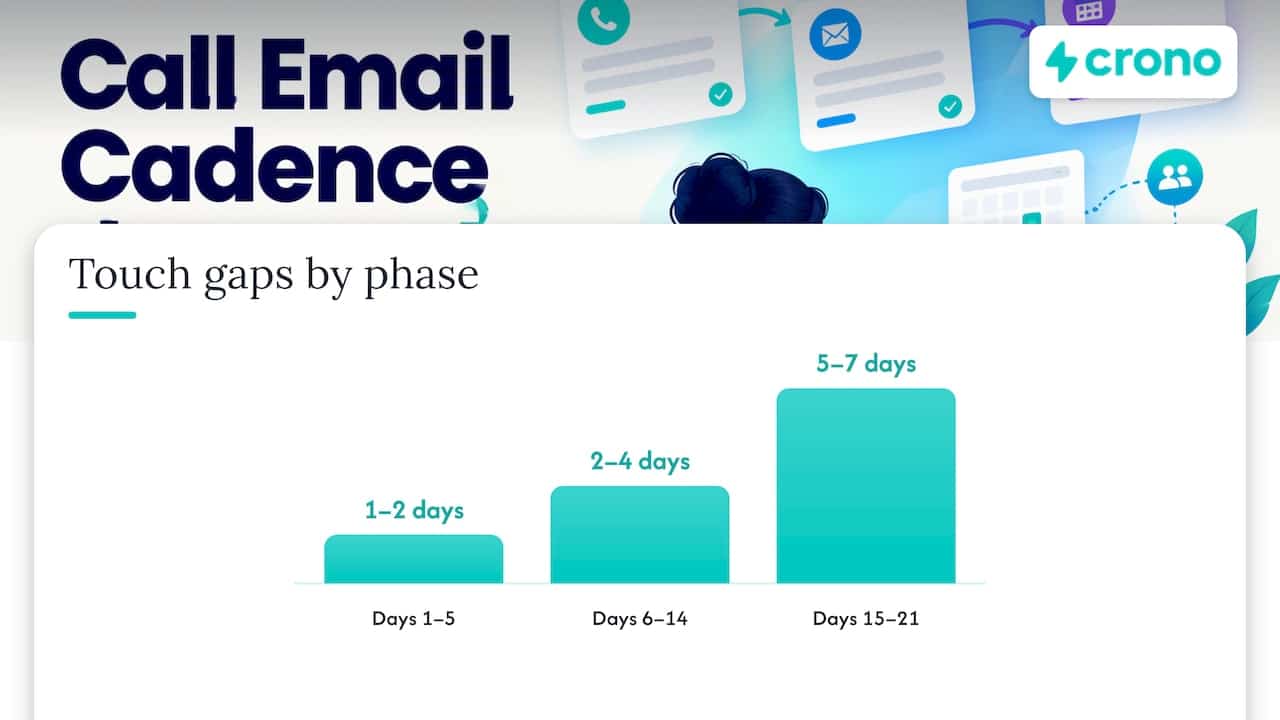
On spacing, follow a simple principle: tight at the start, wider at the end.
- Days 1 to 5: touches every one to two days while your name is fresh.
- Days 6 to 14: gaps of two to four days.
- Days 15 to 21: gaps of five to seven days, ending with a short breakup email.
Timing within the day matters less than consistency. Test call windows (early morning and late afternoon are common choices) against your own connect rates and keep the winners.
A 12-touch call and email cadence template
Use this as a starting point and adapt it to your ICP. It runs 21 days with six emails, four calls (three with voicemail) and two LinkedIn touches.
| Day | Channel | Purpose |
|---|---|---|
| 1 | Short, personalized opener tied to a trigger or role-specific problem | |
| 2 | Call + voicemail | Reference the email, state one reason you are calling |
| 4 | Connection request with a one-line note, no pitch | |
| 5 | New angle: a short customer result or relevant data point | |
| 8 | Call + voicemail | Different hook: a question about how they handle the problem today |
| 10 | Useful asset or idea tied to their industry | |
| 12 | Light engagement with their content or a short message | |
| 14 | Call | Last attempt; leave a voicemail only if you have a new reason |
| 16 | Direct ask for 15 minutes with two time options | |
| 18 | Call + voicemail | Short and specific, offer to send details instead |
| 19 | Forward-to-the-right-person ask | |
| 21 | Breakup email: close the loop, no hard ask |
This follows the same logic as other multi-touch structures that run from a personalized email on day one through a call with a voicemail tied to the email to a breakup email near day 14, only stretched over three weeks for higher-value accounts.
What to say at each touch
The most common failure is repetition: touch four says what touch one said, only shorter and more apologetic. Give every touch a job.
Emails
- Opener: one specific observation, one problem, one low-friction question. Keep it under about 100 words. Our cold email template for B2B software companies shows a working structure.
- Follow-ups: each adds new information: a result, a data point, a different stakeholder’s view.
- Breakup: acknowledge the silence, say you will stop, and leave one easy door open such as a referral. It works because it asks for nothing hard.
Calls and voicemails
- Open with who you are and why you are calling in one sentence, then ask permission to continue.
- Reference the email: “I sent a note Tuesday about onboarding delays.”
- Keep voicemails under 25 seconds, with a single reason to reply and your number said slowly.
- Prepare an opener per persona. Our guide on opening a cold call with AI covers the first ten seconds in detail.
Personalization that scales
Personalize on three layers: account (what the company is doing), role (what the person is measured on) and moment (a signal such as a hire, funding round or content engagement). Reps should spend research time on the moment layer, since that is what makes a message feel timely.
Use signals to break out of the cadence
A fixed calendar is a starting point, not a rule. If a prospect opens an email three times, visits your pricing page or replies to a LinkedIn message, pause the sequence and call. Kazanjy’s handbook makes the same point: use opens and clicks to prioritize who gets a call and to break out of the cadence to phone someone who just opened an email.
The same logic applies to the other end of the funnel. Reading on using prospect behavior to adjust outreach and nurture helps when you decide what happens to contacts who engage but do not book. Move them to a slower, content-led track rather than dropping them.
Measure and adjust
Four metrics are enough to run a cadence well:
- Reply rate: replies divided by contacts reached.
- Meeting rate: meetings booked divided by contacts entered.
- Touches to meeting: shows where in the sequence the value sits.
- Completion rate: the share of contacts who receive every touch, which exposes reps skipping steps.
Change one variable at a time: subject line, call timing, number of touches or the day-one angle. Give each test enough contacts to see a pattern before you decide. If most meetings come from touches 1 to 5, shorten the cadence. If they come late, your early touches probably lack a clear reason to respond.
For non-responders, recycle them after 60 to 90 days with a new angle rather than restarting the same sequence.
Our view: execution is the bottleneck
Most teams do not fail because they lack a cadence. They fail because the cadence lives in a spreadsheet or a single tool while signals, contact data and CRM records sit somewhere else. Reps skip the call step, forget the voicemail, or keep emailing someone who already replied.
We built Crono as a sales execution layer so the cadence runs across the stack you already have. Buying signals decide who enters a sequence and who gets a call now. Data enrichment supplies the contact details. Workflows handle repetitive steps, and AI agents help draft personalized messages while your reps focus on conversations.
Our advice: start with one segment, one cadence and the four metrics above. Once the pattern is clear, automate the repeatable parts and keep humans on the high-value calls.
Alex
Run your cadence in one place
A call and email cadence only works when every step happens on time with the right data. Crono connects your CRM and sales tools so signals, enrichment, multichannel outreach (LinkedIn, email, calls) and pipeline tracking sit in one workflow. Plans start at €79 per month per seat for Pro and €119 per month per seat for Ultra, with credits for AI and enrichment tasks available through the Agentic Sales Engine, from €99 per month for 10,000 credits.
For a deeper look at channel mix, read our multichannel outreach playbook, and see how timing shapes results in the power of timing in multichannel strategies.
FAQ
How many calls should be in a cold email and call cadence?
A common range is three to four calls inside a 10 to 12 touch sequence, with voicemails on some of them. Place the first call within one to two days of the opener, then space later calls a week or so apart. Raise the call share for high-value accounts where direct dials are available.
Should I call or email first?
For cold prospects, email first and call second works well because the call can reference a message already sent. For prospects showing a clear signal, such as a pricing page visit or a reply, call first while the interest is fresh.
How long should a cadence run before I stop?
Most cold B2B cadences run 17 to 21 days, with 8 to 12 touches. End with a breakup email, then move the contact to a slower nurture track and re-engage in 60 to 90 days with a new angle.
Do cold emails still work?
They do, with lower averages than a few years ago. Reported reply rates range from about 2.7% to 7% depending on the dataset, so targeting, data quality and pairing email with calls matter more than volume.
Sources
- Prospecting Cadence, Founding Sales handbook
- B2B Outbound Benchmarks 2026, Konsyg
- Cold Calling vs Cold Email: 1.29 million emails analyzed
- Cold outreach benchmarks 2025, Belkins
- Cold outreach sales cadence: how many touchpoints work
- Cold Calling vs Cold Emailing in B2B
- Lead nurturing explained
